Posts made in November 2026

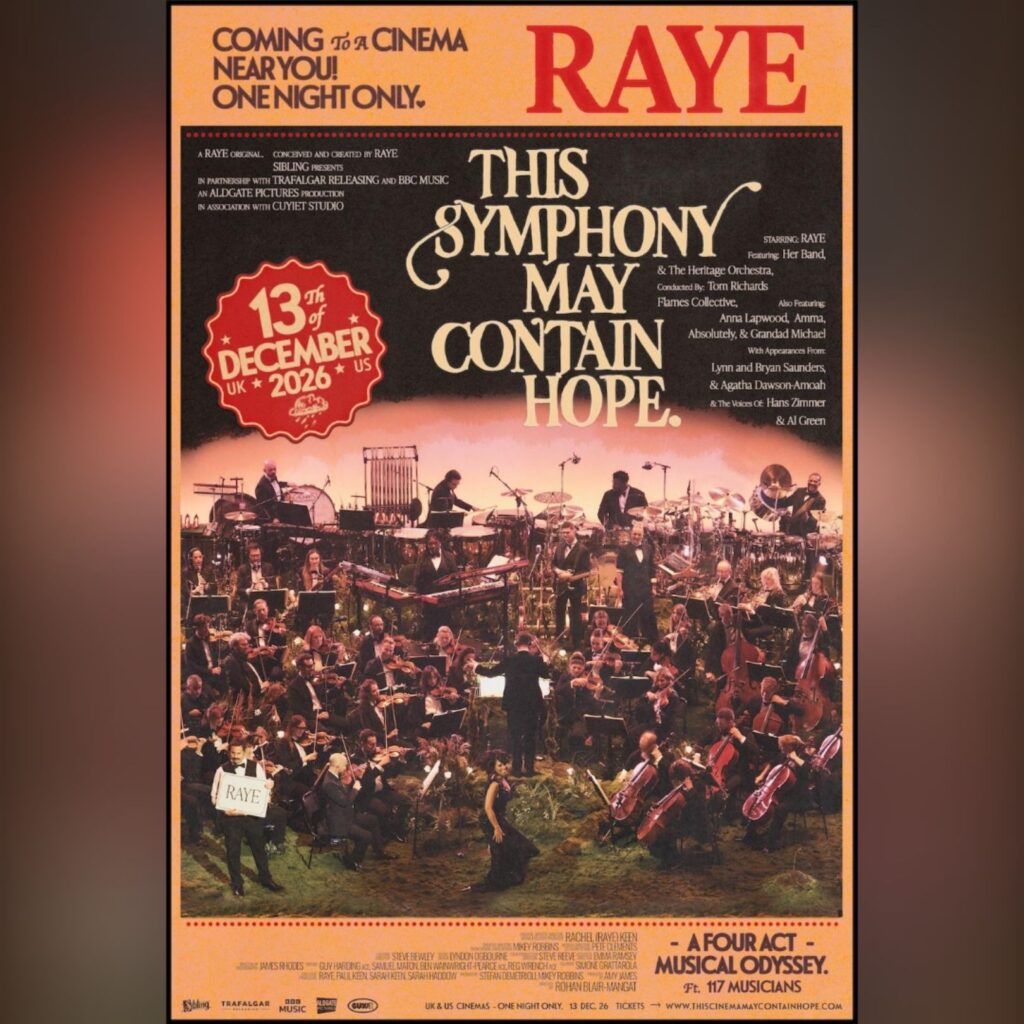
RAYE 'THIS SYMPHONY MAY CONTAIN HOPE." ONE NIGHT ONLY CINEMA RELEASE ON DEC 13, 2026 via 360 MAGAZINE.

RAYE ‘THIS SYMPHONY MAY CONTAIN HOPE.” ONE NIGHT ONLY CINEMA RELEASE ON DEC 13, 2026

15x GRAMMY Award-nominated artist RAYE announces a one-night-only global cinema event for THIS SYMPHONY MAY CONTAIN HOPE., a historic concert film capturing her October 2026 performance at London’s iconic Royal Albert Hall. Screening at over 750 cinemas worldwide on December 13th, the film sees the record-breaking BRIT Award winner perform her Mercury Prize-winning sophomore album, THIS MUSIC MAY CONTAIN HOPE., in its entirety, reimagined through sweeping, maximalist orchestral arrangements. The film is an extended cinema version with additional bonus content exclusive to cinemas.

“This film may contain 117 musicians, my beautiful sisters & grandparents, belted notes, large orchestral climaxes, dramatic endings, musical medicine and fields of golden & green on our musical quest to HOPE. Set inside our beloved Royal Albert Hall, I hope you can feel our passion and utter heart through the big screen speakers. This Symphony May Contain Hope.” – RAYE

The film was brought to life by award-winning director Rohan Blair-Mangat (Jay Z, Nas, Kacey Musgraves, Bryson Tiller), alongside GRAMMY®-nominated production company Aldgate Pictures, creative director Mikey Robbins and musical director Pete Clements. THIS SYMPHONY MAY CONTAIN HOPE. captures an artist at an extraordinary moment in her career. Going far beyond the conventional concert film, RAYE draws her audience into a world of breathtaking intensity, where every lyric carries weight, every crescendo hits deeper and every feeling sits impossibly close. Exhilarating, heartbreaking, joyful and profoundly moving, it’s a cinematic experience that leaves audiences hanging on every word.

At the center of the production is RAYE’s performance, alongside 117 musicians, including The Heritage Orchestra, conducted by Tom Richards, vocal ensemble the Flames Collective, and organist Anna Lapwood. RAYE transforms the celebrated concert venue into the setting for a four-act musical odyssey through the seasons of life. Going far beyond the conventional concert film, THIS SYMPHONY MAY CONTAIN HOPE. is an exhilarating, heartbreaking, joyful and profoundly moving cinematic experience, where every lyric carries weight, every crescendo hits deeper and every feeling sits impossibly close. Filmed in October 2026, the performance captures the extraordinary connection between RAYE, the musicians and the audience, with Rolling Stone UK describing the evening as “a spectacular symphony of salvation” in a five-star review. The evening is also a deeply personal family affair, with RAYE joined on stage by her Grandad Michael, her sisters Amma, Absolutely and Katelyn, and her Grandma Agatha.

RAYE made history in 2024 by winning six BRIT Awards in a single night, the most ever won by any artist, and her sophomore album further showcases her evolution as an independent artist, songwriter, composer, producer and arranger. Now with the buzz around her 11 GRAMMY® Awards nominations, matching the record for the most nominations received by a female artist in a single year, RAYE continues to shatter expectations and carve her own path. THIS SYMPHONY MAY CONTAIN HOPE. is an immersive cinematic spectacle infused with big-band crescendos, theatrical storytelling, and the indescribable stage presence that is uniquely RAYE’s.

Styled by Eniola Dare, RAYE’s wardrobe brings the film’s seasonal four part journey to life through a series of distinctive designer looks. Opening the performance in a faux fur coat by DUCIE during “I Will Overcome,” RAYE transitions into a winter look by Georges Hobeika, featuring embellishments inspired by dead, dried leaves, followed by a spring design by Paolo Sebastian adorned with a nightingale bird referencing Nightingale Lane. For summer, RAYE wears a design by Rasario inspired by the perfect blue summer sky, before closing out in an encore look by Ilya Migmoon.

At its heart, the film is a celebration of family, faith, resilience and the extraordinary power of connection. A triumph in every sense, it’s a testament to an artist who continues to shatter expectations, carve her own path, and remind us that music is indeed medicine.

Following the cinema presentation, THIS SYMPHONY MAY CONTAIN HOPE. will broadcast for viewers in the UK later in December, on BBC One and BBC Radio 2.

Further international cinema screenings are planned for early 2027.

RAYE 'THIS SYMPHONY MAY CONTAIN HOPE." ONE NIGHT ONLY CINEMA RELEASE ON DEC 13, 2026 ACROSS 3 COUNTRIES via 360 MAGAZINE.

PURCHASE TICKETS

THISCINEMAMAYCONTAINHOPE.COM

FOLLOW RAYE

Official Website

Instagram

TikTok

X

Facebook

YouTube

Spotify

What Makes a Tarot Deck Feel Premium? Art, Size, and Finish

You turn over a tarot card and spot a tiny cat tucked into the corner. You pull another card, and there it is again, this time asleep under a chair. Little details like that make you want to go through the whole deck. But when you sit down to use it, you’ll also notice whether the titles are easy to read, how the artwork looks under the light, and whether the cards slide apart comfortably.

If you’re making your own tarot deck, the art, card size, cardstock, and finish all contribute to that experience. You don’t need an elaborate design or the most expensive materials to make a deck feel premium.

Give the Cards Something in Common

Maybe your deck takes place in a seaside town, or maybe it follows the cast of your own comic. Either way, you can give each card its own scene and still make the deck feel like it belongs together. Start with a few choices you can reuse, such as the lettering, border, color palette, and where the card name goes.

Say you’re drawing a deck set in a little seaside town. The Fool is heading out with a backpack, and The Moon shows an empty pier at night. Those scenes look different, but a few shared colors or the same hand-lettered titles can tie them together. Lay the cards side by side and see if they look like they came out of the same box.

Think about how someone will read the cards, too. A traditional tarot deck has 78 cards, and recurring visual cues can help readers distinguish the suits and recognize important symbols. Make sure those symbols stand out against the background, and check that long card names remain legible at the finished print size. Decorative lettering works best when it is still easy to read.

Give the backs some attention, too. If you want readers to draw cards without knowing which way up they’ll be, rotate your back design 180 degrees. Does it look the same both ways? A little moon near the top can give the direction away. A symmetrical arrangement of stars or waves keeps it a surprise. Using the same back design across the deck also prevents individual cards from being recognized face down by their artwork.

Pick a Size You Can Picture Using

Before you settle on a tarot card size, think about where the deck will get used. Will someone spread the cards out on a kitchen table or pull one every morning at a crowded desk? A bigger card gives your art more room, but it also takes up more room in the hand and on the table. A full stack of wide cards can be awkward to shuffle, especially for readers with smaller hands.

If you plan to print custom tarot cards with Vograce’s cold foil option, there are three sizes to choose from. The compact 59 × 102 mm format works well for travel, daily draws, or small tables. The 70 × 120 mm format gives illustrations more space while keeping the cards narrower than the largest option. At 89 × 146 mm, intricate artwork and small details have more room to breathe, though the deck will require more space for shuffling and larger spreads.

If you’re deciding between sizes, print the same design at each actual size and trim the copies along their edges. Hold them in your hand, then set them on the table and see how easily you can read the title from your seat. Try laying out several paper mockups together, too. They can show how much space a reading will need, even if they cannot reproduce the feel of the finished cardstock.

Choose a Finish That Suits the Art

A deck can look different under a desk lamp than it does by the window. Matte finishes generally reduce glare, which is handy if people will read the cards under bright light. They can also suit soft watercolor illustrations or muted color palettes. Gloss gives the surface more shine and can make bold colors appear more vivid, although reflections may hide some details. If you’re torn between the two, compare printed samples under the kind of light you use at home.

Foil is another way to add shine in specific spots. Think of a thin gold line around a lantern or a few silver stars above a rooftop. When someone tilts the card, those parts catch the light. Choose which detail you’d like a reader to notice first, rather than highlighting everything at once. A small accent can have more impact when it contrasts with the surrounding artwork.

If you choose cold foil or another metallic effect, check how your printer needs the artwork to be prepared. Foil areas may need a separate design layer, and very fine lines or tightly spaced details may not reproduce as intended. Keep essential symbols and titles readable even when the metallic areas reflect light.

See How the Cards Feel in Your Hands

Cardstock is the paper the cards are printed on. A heavier stock can give a deck a substantial feel, but weight alone does not determine quality. Thickness, stiffness, flexibility, opacity, and surface coating all influence how the cards behave. A deck that is too rigid may be difficult to shuffle, while very flexible cards can bend easily. The face artwork should not be visible through the back during ordinary use.

If your printer offers samples, pick them up and try dealing a few cards. Do they slide apart easily? Can you pick one up off the table? Try an overhand shuffle or fan several cards across a flat surface. Pay attention to smooth corners, clean edges, and whether the surface feels too slippery or sticky. A single card can feel comfortable to hold while a full stack of the same stock feels stiff in your hands.

Take a close look at the edges while you’re at it. A narrow border can make even a small shift in trimming easy to see. If a sample has a border that looks wider on one side, try giving it more room or letting the background run to the edge. Follow your printer’s bleed and safe-area guidelines, keeping titles, faces, and important symbols away from the trim line. Check dark areas and fine details on a printed proof, since they may look different from the screen.

Consider how the cards fit into their box as well. A snug but easy-to-open package protects the edges during storage, and a box that carries the same colors or lettering as the cards makes the deck feel more complete. If you include a guidebook, allow enough room for it alongside the finished stack.

Final Thoughts

A tarot deck feels premium when the artwork is easy to see, the cards are comfortable to hold, and the finish suits the design. The best choices are the ones that support how the deck will actually be used.

Try a few cards before you commit to the whole deck. Pick a busy illustration, one with a long name, a dark design, and one you’d like to see in foil. Set them on the table, read the titles, check the backs, and see what catches your eye when you pick them up. If you find yourself turning a card back over to look at that tiny cat again, you’ve got a detail worth keeping.

On Wednesday, December 9, artist Kyle Lucks will unveil a special commissioned painting of Jackie Kennedy alongside the White House Historical Association via 360 MAGAZINE.

Jackie Kennedy’s 1962 White House Tour Look

Kyle Lucks is a portrait artist based in West Palm Beach, Florida, recognized for creating colossal acrylic artworks of athletes, horses, musicians, cultural icons, and historical figures.

On Wednesday, December 9, artist Kyle Lucks will unveil a special commissioned painting of Jackie Kennedy alongside the White House Historical Association (the organization Jacqueline Kennedy Onassis founded in 1961).

The painting centers on one of her most famous looks. In 1962, millions of Americans watched Jackie lead the first televised tour of the White House, but the broadcast aired in black and white, so only still photographs ever showed its color. Lucks brings it to life in full color, and in patriotic ones: the red of the dress she wore for the tour, her signature white pearls, and the blue of the Blue Room as she knew it. The background repeats the light blue fabric and gold rosettes of the room’s Bellangé chairs, and the pearls are painted in a pearlescent metallic paint, so they shimmer the way they would in real life.

The piece is part of Lucks’s signature Jackie series, in which the oversized sunglasses that became her signature reflect the places tied to her life and style, from The Breakers Hotel and Worth Avenue in Palm Beach to JFK’s 1961 inauguration. Rather than start from scratch, the Association asked him to continue the series, and this time, with her confident, stoic gaze, Jackie looks out at the White House reflected in her lenses.

To get every detail right, Lucks pored over thousands of photographs, books and documentaries. He painted Jackie’s face completely before adding the glasses, then built up the White House in layers of transparent paint so her eyes shine through the reflection, with a signature varnish that makes the lenses look the way they would in real life.

The painting will be revealed on December 9 at “Art and White House History,” the latest gathering of “The Long View: A Monthly Roundtable Lunch” in Washington, D.C. The new lunch series by the White House Historical Association explores the vast history of the White House through a new topic each month. The gatherings bring together individuals from corporate, diplomatic and nonprofit organizations. December’s lunch will examine the place of art in White House history.

On Wednesday, December 9, artist Kyle Lucks will unveil a special commissioned painting of Jackie Kennedy alongside the White House Historical Association via 360 MAGAZINE.
MGA RELEASES MUSIC VIDEO FOR “PROJECT 4” AN ENGLISH-LANGUAGE SONG, AS JAPANESE SUPERSTARS CONTINUE GLOBAL ASCENT via 360 MAGAZINE.

MGA RELEASES MUSIC VIDEO FOR “PROJECT 4” AN ENGLISH-LANGUAGE SONG

Japanese pop-rock superstars MGA (Mrs. GREEN APPLE) have unveiled the official music video for “Project 4,” a song performed almost entirely in English. Featured on their latest album, POPS, the track marks a new creative milestone for the trio, whose extraordinary success in Japan has helped establish them as one of the world’s most popular acts.

Blending live instrumentation with electronic production and heavily processed vocals, “Project 4” finds MGA exploring a colder, more detached sound that challenges their established musical identity. Its fragmented structure and commentary on algorithm-driven culture reflect the band’s willingness to push creative boundaries while questioning the digital landscape that shapes how music is consumed. The accompanying video brings the song’s concept to life in a surreal, constantly shifting world of vibrant landscapes, futuristic cityscapes and fantastical creatures, as the band and dancers move through increasingly distorted, digitally manipulated environments.

A cynical satire of a modern society caught up in social media and digital tools, “Project 4” pairs experimental pop with an entirely new creative direction for the band. Its vivid, colorful soundscape makes it one of the most distinctive tracks on the album.

From the earliest stages of recording, Motoki Ohmori told the team he wanted to dance with kazuki of s**t kingz. With kazuki on board as choreographer, work began on a routine based on Ohmori’s ideas. The two exchanged ideas as they developed the choreography, which ultimately became a borderless style unique to MGA, free from any one genre. Its difficulty far surpasses that of “breakfast,” revealing a new side of the trio’s potential.

Ohmori developed the video’s concept from his visual image of the song. To bring his ambitious vision to life, he enlisted director Blake Farber, who works between New York, São Paulo and Madrid. Creators from around the world joined the production, including Polish Director of Photography Andrzej Rudz, Australian lighting director James Thompson, Brazilian offline editor Jon Kadocsa and Spanish VFX artist Andrei Bulatchik. 

The video follows the members as they travel through four different worlds. Created entirely with visual effects, it captures the band stepping into a new phase and leaping into a brighter, more colorful world. The director describes the experience as “visual candy.” Look out for the richly colored imagery, created from footage shot against a gray backdrop—a technique still rarely used in Japan.

Ahead of the new video, MGA released the music video for “Cinderella” in October, a sweeping, dramatic track that pairs the band’s signature sound with orchestration and explores the tension between impossible dreams and the hope of a happy ending. The music video for “Cinderella,” directed by frontman Motoki Ohmori, joins videos for album tracks “Kyohan” and “A・Posteriori.” Together, these visuals extend the world of POPS and showcase the band’s genre-blurring creativity.

Released in September, POPS debuted at No. 1 on Billboard JAPAN’s Hot Albums chart and held the top spot for four consecutive weeks. It also spent six consecutive weeks at No. 1 on the streaming chart. The album earned Triple Platinum certification from the Recording Industry Association of Japan for October 2026, reaffirming MGA’s position at the forefront of Japanese music.

The band’s influence extends well beyond the charts. This November, MGA launched two major nationwide campaigns, showing how they connect with audiences across Japan in areas beyond music.

On November 12, MGA announced a new partnership with Google. The trio – Motoki Ohmori, Hiloto Wakai and Ryoka Fujisawa – star in a series of television and digital ads introducing AI Mode in Google Search. The spots capture the members’ playful chemistry as they use technology to explore everyday questions and take on an impromptu challenge to strike matching gorilla poses. To mark the collaboration, Google also launched a special interactive Search experience that showers the screen with green apples and confetti. WATCH THE GOOGLE CAMPAIGN HERE

MGA also appears in a nationwide campaign from the Japanese Cabinet Office’s Government Public Relations Office raising awareness of online misinformation and disinformation. The campaign centers on the Japanese mnemonic “Ma-Sa-Ka,” which encourages people to pause, search and check. In one commercial, a false announcement claims the band has changed its name before revealing that the news is a hoax. The spot also uses digitally generated imagery to show how convincing fabricated information can look. The initiative spans television, digital platforms, transit advertising and schools across Japan. WATCH THE CAMPAIGN HERE

These partnerships reflect MGA’s broad influence in Japan, which now reaches into technology, education and social issues. The band’s international profile is growing as well: MGA ranked No. 13 on IFPI’s 2025 Global Artist Chart, placing them among the world’s best-selling recording artists.

With POPS continuing its chart success and “Project 4” marking a new creative milestone, MGA are closing out a full year while building momentum internationally. Their Mrs. GREEN APPLE Ringo Jam Tour “SHADOWS” continues across Japan through December 28.

MGA ONLINE

Website | YouTube | X | Instagram | TikTok | Facebook

DJ KHALED HOSTS 4TH ANNUAL WE THE BEST FOUNDATION GOLF CLASSIC AND BIRTHDAY BASH via 360 MAGAZINE.

DJ KHALED HOSTS 4TH ANNUAL WE THE BEST FOUNDATION GOLF CLASSIC AND BIRTHDAY BASH

Celebrating a half-century plus one of gratefulness and greatness in style, GRAMMY Award-winning, global megastar DJ Khaled will host his third annual WE THE BEST FOUNDATION GOLF CLASSIC and his 51st birthday party on December 2 at a private location in Miami Beach followed by the Celebrity Golf Tournament on December 3 in Miami Beach, FL. 

Following two highly successful events, the 2026 installment has all the makings of the biggest, boldest, and best GOLF CLASSIC to date. 

Once again, Khaled has joined forces with longtime partner Jordan Brand to present the hottest celebrity golf tournament in North America. This time around, confirmed participants range from Academy Award-nominated superstar actor, producer, entrepreneur, and philanthropist Mark Wahlberg to CC Sabathia,  Victor Cruz, Anthony Anderson, Alonzo Mourning, Fat Joe, Michael Eaves, Kenny Smith, Jeezy, and many more. Bringing together a true “who’s who” of icons across film and television, music, and sports, the event starts promptly at 10am ET. Moreover, all proceeds will benefit the We The Best Foundation and its various initiatives supporting education. 

The night before, Khaled will entertain guests during the WE THE BEST FOUNDATION GOLF CLASSIC WELCOME RECEPTION and his 51st BIRTHDAY CELEBRATION at a private location in Miami beach. Friends and family will ring in his monumental birthday together, beginning at 7pm ET.

FOLLOW DJ KHALED

Twitter | Instagram | Tik Tok

DJ KHALED HOSTS 4TH ANNUAL WE THE BEST FOUNDATION GOLF CLASSIC AND BIRTHDAY BASH via 360 MAGAZINE.
Screenshot
Las Vegas residencies via Vaughn Lowery photography and 360 MAGAZINE.

Why Las Vegas Residencies Became Music’s Biggest Payday

Touring is brutal. Trucks, buses, a different bed every night, and a crew of hundreds who need paying whether the arena is full or not. A residency flips the model: one stage, one hotel, one set of production costs, and a casino resort quietly picking up the bill. When Jeezy brought The Legend of the Snowman to PH Live at Planet Hollywood this year, with an orchestra in the pit and a Black Tie dress code every night, it was a neat picture of how far the format has come from the lounge act.

The reason it works is the building around the theater. A fan who flies in for a show also books a room, eats dinner, and walks through the gaming floor on the way to their seat. That floor is where the money ultimately comes from, and it is the same floor Kiwi fans back home recognize as pokies, which many of them now play on licensed pokies sites rather than at the pub. Only players aged 18 or over should be doing either, and the Gambling Helpline (0800 654 655) is there for anyone who needs it.

The residency boom

The modern Vegas residency starts with a very large check. When Celine Dion opened A New Day… at Caesars Palace in March 2003, Time reported a deal worth around $100 million plus a share of profits, for five shows a week across 40 weeks a year. The resort built her a $95 million, 4,000 seat theater called the Colosseum to hold it.

It paid off. According to Billboard Boxscore, that first run grossed $385.1 million from 714 shows between 2003 and 2007, still the biggest Las Vegas residency on the chart Billboard published in 2018. Elton John followed into the same room, and Britney Spears took Piece of Me to the Axis at Planet Hollywood for $137.7 million over 248 shows. Each of them proved something the touring industry had resisted: an audience will travel to the artist, if the artist stays put.

Follow the money

So why would a resort pay an act a fortune to stay for years? Variety put it bluntly at the time of the Dion launch: Caesars Palace had decided to “write the big checks,” and the column noted the property needed a new sell, which was showbiz. Variety’s 2003 column on the Dion deal reads like a business plan more than a review.

The logic has barely moved. A headliner who sells out four thousand seats a night supplies footfall that no advertising budget matches. Those guests fill rooms, take restaurant tables and walk past gaming tables and machines at exactly the moment they are most relaxed. Time quoted the Caesars Palace president saying the casino had been reconfigured so that it captured every person coming in and out of the theater. The ticket is almost a loss leader for the property, and the show works as a very expensive front door.

The slot floor pays the band

Look at who really funds the stage. In Nevada’s gaming abstract for the fiscal year ended June 30, 2025, gaming was still the single largest revenue line for the state’s 305 biggest licensees, at $11.2 billion or 36.4% of $30.8 billion in total revenue. Rooms came second at 27.3%. Food, beverage and other income made up the remainder.

That is why a resort can afford an orchestra every night, or a theater that sits dark between runs. The machines carry the building, and the building carries the band. For an artist, a residency is a deal with the house, and the house has a very reliable income to lean on.

Who is next

The pipeline shows no sign of drying up. LISA takes the Colosseum stage on November 13 and 14, then again on November 27 and 28, billed as the first K pop artist to hold a Las Vegas residency. LL Cool J announced at the end of October that Rock the Bells: The Residency will play 11 nights at Dolby Live at Park MGM in May and July 2027, with guests changing nightly.

Both pitches share a theme with Jeezy’s run. The residency is no longer a retirement home for legacy acts. It is where an artist with a big catalog and a loyal audience can build a show properly, play it repeatedly and get paid for it in a way a tour rarely allows.

Back at the Strip, the lights go down, the orchestra settles, and somewhere behind the stage doors the slot floor keeps humming, paying for the encore.

CANCER CULTURE RAISES OVER $600,000 FOR STAGE IV BREAST CANCER RESEARCH via 360 MAGAZINE.

CANCER CULTURE RAISES OVER $600,000 FOR STAGE IV BREAST CANCER RESEARCH

TURNING AWARENESS INTO ACTION

Patient-led nonprofit spotlights its exclusive focus on metastatic breast cancer research, $200,000 raised at NYFW and a limited-edition Shaneli jewelry collaboration 

During Breast Cancer Awareness Month, Cancer Culture is drawing attention to a critical distinction: its mission is focused specifically on funding research for Stage IV, or metastatic, breast cancer — the advanced form of the disease that remains incurable. 

Unlike broader breast cancer awareness initiatives, the patient-led nonprofit prioritizes research aimed at improving treatments and finding cures for people living with Stage IV disease. Cancer Culture has raised more than $600,000 over the past year, including $200,000 through its seventh annual New York Fashion Week Runway Experience, and directs 100% of donations to metastatic breast cancer research, without deducting operating expenses. 

“Awareness alone is not enough,” said Beth Love, Co-Founder of Cancer Culture, who lives with Stage IV breast cancer. “We need to turn attention into meaningful research funding that advances treatments and brings us closer to cures.” 

FASHION WITH A PURPOSE 

Cancer Culture’s seventh annual Runway Experience at Thompson Central Park in New York City featured breast cancer patients, survivors and previvors as runway models, raising $200,000 for curative-intent metastatic breast cancer research. 

Featured designers included Dressed in LALA, AnaOno, Kate Hewko, Madison Chamberlain, Cosmic Collective and ADG Boston, with Dolce Vita as Premier Shoe Partner. 

Beyond the runway, Cancer Culture joined Stage IV metastatic breast cancer thrivers currently fighting for their lives in a Times Square protest demanding greater attention and funding specifically for Stage IV research. The demonstration underscored why this often-overlooked research priority is central to Cancer Culture’s mission. 

Continuing to unite fashion and philanthropy, Cancer Culture is introducing “Strength in Every Shade,” a limited-edition jewelry collaboration with Shaneli for Breast Cancer Awareness Month. The handcrafted collection features pink stones, black diamonds and colors inspired by the Cancer Culture logo, including teal, purple and green. Signature designs include a symbolic ribbon necklace and diamond floral rings. 

Proceeds will benefit Cancer Culture’s metastatic breast cancer research mission. Shop the collection: https://shaneli.com/collections/cancer-culture

MISSION ROOTED IN PERSONAL EXPERIENCE 

Founded in 2022 by breast cancer advocates Beth Love and Rachel Burns, Cancer Culture was created to amplify patient voices and direct critical funding toward research for Stage IV disease. 

“As a breast cancer survivor, I’ve seen too many lives lost to metastatic disease,” said Rachel Burns, Co-Founder of Cancer Culture. “We need more than awareness. We need research focused on finding cures so that metastatic breast cancer is no longer a terminal diagnosis.” 

As October 13 marks Metastatic Breast Cancer Awareness Day, Cancer Culture urges individuals and businesses to prioritize Stage IV research and the patients whose lives depend on it. 

Awareness gets attention. Stage IV research creates change.

ABOUT CANCER CULTURE 

Cancer Culture is a patient-led nonprofit distinguished by its dedicated focus on Stage IV (metastatic) breast cancer research. Through advocacy, storytelling, fashion and fundraising, the organization works to advance research toward better treatments and cures for metastatic disease. Inspired by the legacy of metastatic breast cancer advocate Champagne Joy, Cancer Culture directs 100% of donations to metastatic breast cancer research. 

Learn more at www.cancerculture.org. 

The Growing Appeal of Unique Automotive Assets

Automotive collecting now extends well beyond the vehicle itself. Distinctive registration identifiers, original documents, period accessories and verified ownership records can all carry cultural and financial value. These assets give collectors another way to express personal taste while preserving details connected to a vehicle’s past.

Interest has grown alongside a broader shift in motoring culture. Collectors are paying closer attention to provenance, scarcity and condition, while online marketplaces have made specialized assets easier to find. Still, buyers need to separate genuine rarity from clever marketing before committing their money.

Tangible Value in Modern Motoring Culture

A collectible vehicle offers something physical in a market increasingly filled with digital products. You can drive it, display it and study the craftsmanship behind it. The same appeal applies to associated assets such as registration identifiers, factory literature and documented service histories. Each object adds another layer to the vehicle’s identity.

The expanding collectible car market reflects this wider interest. Modern enthusiasts may collect vehicles from the 1980s, 1990s and early 2000s, not only models traditionally labeled as classics. A limited-production sports car, an early luxury SUV or a well-preserved performance sedan may now attract buyers who remember seeing those models during childhood.

Tangible value still depends on evidence. A seller’s description should match service invoices, registration records, build information and inspection findings. If an asset has an unusual history, ask for documents that establish when it was issued or acquired. Photographs should also show its current condition clearly.

Financial return should remain one consideration among several. Storage, maintenance, insurance and transaction charges can reduce gains even when a vehicle’s sale price rises. Broader guidance on classic car values highlights why condition, provenance and ongoing ownership costs deserve careful review. The strongest purchases usually combine personal relevance with facts that another collector can verify later.

Rarity as the Ultimate Driving Factor

Scarcity creates attention, but useful rarity must be easy to explain. A vehicle may be scarce because production was limited, few examples survived or a particular specification had a short production run. Registration identifiers can be desirable for similar reasons, including a short format, memorable sequence or clear connection to a name.

For buyers ready to compare options, listings of private number plates for sale can show how length, letter combinations and dateless formats affect asking prices. Set a firm spending limit before searching because an identifier with emotional relevance can quickly feel more valuable than comparable listings suggest. Check every character carefully as well. A sequence that needs a strained explanation may have weaker resale appeal than one people understand immediately.

Rarity alone cannot establish fair value. An uncommon asset with limited demand may take months or years to sell, while a less scarce example tied to a popular model can attract several buyers. Review completed sales where available and compare like with like. Asking prices reveal seller expectations, not confirmed market value.

This distinction becomes clearer at the top end of the market. Discussions of ultra-luxury car investment often focus on low production numbers, brand history and documented specifications. The same logic works at more accessible price levels. A rare color is more compelling when factory records confirm it, and a special identifier is stronger when its ownership and transfer status can be checked.

Where Collectors Source Rare Identifiers

Specialized marketplaces give collectors access to a much broader selection than local dealers or word of mouth. Search tools can narrow thousands of listings by letters, numbers, format and price. Alerts can also help when the desired combination isn’t currently available.

Auctions remain valuable because competitive bidding provides a visible test of demand. Yet a dramatic result can distort expectations when two determined bidders focus on the same lot. Analysis of recent auction trends shows why individual sales need context, particularly when condition, specification and provenance vary sharply between similar vehicles. Look at several results over time instead of treating one headline price as a universal benchmark.

Private sales may offer more room for discussion. They also place greater responsibility on the buyer to verify identity, ownership and transfer requirements. Ask the seller to provide current documentation before money changes hands. If the transaction crosses national or regional borders, confirm that the identifier can legally be transferred and used in the intended jurisdiction. Registration systems differ widely, so assumptions based on another country’s rules can create expensive problems.

Collectors should keep a simple comparison file for every serious option. Record the asking price, sale fees, transfer costs, format, documented history and date first listed. Screenshots are helpful because online listings can change. A short written explanation of why the asset appeals to you can also expose an impulse purchase. If the reason rests only on possible appreciation, pause and compare alternative assets with deeper personal or cultural relevance.

Long-Term Preservation of Vehicle Heritage

Preservation begins with records. Keep purchase agreements, transfer confirmations, maintenance invoices and correspondence in both physical and digital form. Scan paper documents at a readable resolution and save copies in two secure locations. File names should include the date and subject, such as “1998-service-invoice” or “registration-transfer-confirmation,” so a future owner can follow the history without sorting through an unlabeled folder.

Physical items need suitable storage. Manuals, photographs and certificates should stay away from moisture, direct sunlight and large temperature swings. Acid-free sleeves can protect paper, while rigid folders reduce creasing. Avoid permanent alterations to original documents, even when a handwritten note seems useful. Put comments on a separate sheet.

Condition reports add credibility for higher-value vehicles and related assets. Photograph the vehicle from consistent angles once or twice a year, including the cabin, identification markings and any known flaws. Record mileage and major work at the same time. This creates a timeline that can support an insurance claim or future sale.

Ownership also has a cultural dimension. A car’s story may include its original specification, a notable former keeper or a connection to a particular design period. Accurate documentation preserves that story without turning rumor into fact. Label unverified information clearly and keep copies of the sources behind confirmed claims.

A rare identifier gains meaning when it fits the vehicle and has a traceable record. Years from now, the most persuasive collection won’t be the one with the longest description. It will be the one whose details can still be proved.

Why Hair Versatility Is Becoming a Bigger Part of Fashion Styling

A fashion look can change dramatically without changing a single piece of clothing. Move the hair from a centre part to a deep side part, and a tailored blazer suddenly feels more glamorous. Pull the same hair into a half-up style, and the outfit takes on a softer, more playful character.

Fashion stylists have long understood the relationship between hair and clothing. On editorial sets and red carpets, hairstyles help establish the mood of a look, draw attention to particular features and create a recognisable silhouette. Hair is not simply the finishing touch. It is part of the visual composition.

Wigs have made this relationship especially interesting because they allow stylists to experiment with different looks without making permanent changes to the wearer’s natural hair.

But versatility is not just about owning several wigs. Sometimes, the more creative approach is discovering how much can be achieved with one carefully chosen piece.

Hair Has Become Part of the Fashion Silhouette

Think about the difference between a sleek centre part and voluminous side-swept waves.

The first creates symmetry and a relatively controlled shape. It can complement minimalist clothing, structured tailoring or an outfit built around clean lines.

The second introduces movement and asymmetry. It can soften a sharp neckline, balance an architectural dress or add drama to a relatively simple outfit.

Neither hairstyle is inherently more fashionable. They communicate different visual ideas.

In fashion photography, this distinction becomes particularly important because the camera captures an entire composition. Hair can frame the face, reveal an earring, create volume around the shoulders or draw attention away from a garment’s details.

Red carpet styling works in a similar way.

A dramatic gown may benefit from hair that stays close to the head, allowing the dress to remain the focal point. A simpler outfit may leave more room for sculptural curls, exaggerated volume or an elaborate updo.

The growing appeal of versatile hair styling reflects this flexibility. Instead of treating a hairstyle as a fixed accessory, stylists can use it as an adaptable part of the outfit.

And that approach is not limited to professional fashion settings.

The same person might want understated hair for work, a more dramatic look for dinner and something playful for a weekend event.

One well-constructed wig can sometimes accommodate all three.

What Lace Frontal Construction Changes

The styling possibilities of a wig depend partly on how its base is constructed.

A lace frontal provides a lace-covered area across the front of the head, allowing the hairline and parting to appear more natural when the wig is fitted appropriately.

Two common configurations are 13×4 and 13×6 lace frontals.

Both generally provide approximately 13 inches of lace across the front, although actual dimensions and construction can vary by manufacturer. The main distinction is the nominal front-to-back depth: approximately four inches for a 13×4 and six inches for a 13×6.

That additional depth can make a meaningful difference when creating longer parts or styles that expose more of the scalp near the top of the head.

It does not, however, mean that every hairstyle becomes possible.

The lace is still limited to a defined section of the cap. Areas beyond it may use different construction methods, and the placement of tracks or other cap components can restrict how the hair is separated or lifted.

This is where the distinction between styling flexibility and unlimited styling freedom becomes important.

A 13×6 frontal may offer more room for certain looks than a comparable 13×4 design, but the finished result still depends on the wig’s density, length, hair direction and installation.

To understand the practical difference, consider three looks created from the same wig.

Look One: The Middle Part for Clean, Modern Styling

The middle part is one of the simplest ways to give a hairstyle a polished, intentional appearance.

Its symmetry works particularly well with tailored jackets, minimalist dresses and clothing that relies on strong proportions rather than decorative details.

For this look, imagine a long human hair wig styled with a smooth centre part and relatively straight lengths.

The hair falls evenly on both sides of the face, creating a balanced silhouette that draws attention to the eyes, cheekbones and neckline.

A 13×6 lace frontal can be useful because its deeper lace area allows the centre part to extend farther back before reaching the non-lace portion of the cap.

That extra depth can make the exposed parting appear more continuous, particularly when the hairstyle is worn flat.

However, a 13×4 frontal can also create an attractive middle part.

The difference becomes more relevant when the wearer wants a longer visible part or greater freedom to adjust its position.

Hair density matters as much as lace depth.

Excessive volume around the roots can make a sleek style difficult to achieve, while careful styling and an appropriate density can help the hair lie naturally.

For a fashion shoot, the middle part also creates a useful foundation for accessories.

Statement earrings, a narrow headband or a structured collar can become more prominent when the hair is kept close to the face.

Look Two: The Deep Side Part for Red Carpet Drama

Now imagine the same wig with the part moved dramatically to one side.

The change immediately introduces asymmetry.

Hair falls across one side of the forehead, while the opposite side can be tucked behind the ear or styled closer to the head.

This is a familiar red carpet technique because it creates movement without necessarily requiring an elaborate hairstyle.

The result can feel glamorous with a satin gown, sophisticated with a tailored suit or deliberately dramatic with an off-shoulder dress.

A lace frontal allows the parting to move within its available lace area.

With a 13×6 construction, the additional depth may support a longer diagonal or off-centre part, provided the desired line remains inside the lace section.

But the number 13×6 does not mean that the lace extends six inches backward at every point across the head.

Actual lace shapes vary, and the usable depth near the sides may be different from the centre.

This is especially important for a deep side part.

If the chosen part extends beyond the lace into the machine-wefted portion of the cap, the underlying construction may become visible.

Hair direction can create another limitation.

A wig that has been heavily styled or set in one direction may require heat styling, washing or additional preparation before it sits naturally in a different part.

The most versatile option is not necessarily the wig with the largest advertised lace area. It is one whose construction supports the specific styling changes the wearer wants to make.

Look Three: The Half-Up Hairstyle for a Softer Silhouette

The half-up hairstyle creates a different kind of transformation.

Instead of changing only the part, it changes the distribution of volume.

Some of the hair is lifted away from the face and secured toward the crown, while the remaining lengths fall around the shoulders.

The result can be romantic, youthful or sophisticated depending on the finish.

Loose waves and face-framing strands create a softer appearance, while a smooth half-up ponytail can look more structured.

Accessories offer another layer of styling.

A ribbon, decorative clip or understated metallic barrette can shift the same hairstyle from casual daytime dressing to an evening look.

For a lace frontal wig, however, the half-up style requires more planning than a simple part change.

A 13×6 frontal can provide useful lace coverage near the front and top, but it does not automatically conceal the construction farther back on the cap.

If too much hair is lifted, tracks or cap sections outside the lace area may become visible.

The amount of hair gathered, the position of the clip and the remaining coverage all affect the result.

Longer hair often makes this style easier to arrange because the lifted section can be secured while leaving enough length below to maintain the intended silhouette.

Density also matters.

A wig with insufficient coverage in the areas being exposed may not support the look convincingly, while an extremely dense wig may create unwanted bulk at the crown.

The attachment method is another consideration.

Styles that pull firmly against the hairline can place additional tension on the lace or attachment points. A comfortable, secure installation and gentle styling are important, especially with delicate lace.

A half-up hairstyle is possible with many lace frontal wigs, but the exact result depends on the construction rather than the frontal dimensions alone.

Does HD Lace Make a Wig More Versatile?

HD lace is frequently associated with natural-looking hairlines, but its contribution to versatility is sometimes misunderstood.

The term generally describes fine, sheer lace intended to appear less noticeable against the skin.

This can be helpful when a hairstyle exposes the front hairline or visible parting.

However, HD lace does not inherently create a larger styling area.

A 13×6 HD lace frontal and a 13×6 frontal made with another lace construction may provide similar nominal parting dimensions.

The difference lies primarily in the properties and appearance of the lace itself.

For shoppers comparing 13×6 HD lace wigs, it is useful to consider both characteristics separately: the 13×6 configuration describes the nominal lace coverage, while HD refers to the lace’s intended visual subtlety.

Neither specification explains everything about the finished wig.

Hairline preparation, knot visibility, cap fit and styling technique still influence how natural the result appears.

A very fine lace material may also require more careful handling, particularly when changing styles frequently.

Versatility involves not only the number of hairstyles a wig can create, but also how comfortably and reliably it can support those changes.

The Details That Determine Whether One Wig Can Do More

The appeal of a versatile wig is easy to understand.

A single piece that works with several outfits can simplify styling decisions, reduce the need for multiple purchases and create more opportunities for experimentation.

But flexibility depends on a combination of features.

Hair length determines whether there is enough material to create waves, ponytails or partially lifted styles.

Density influences the overall silhouette and whether the hair can be gathered without exposing unwanted areas.

Texture affects how easily the wig moves between sleek and voluminous looks.

Cap construction determines where parting and lifting can occur without revealing the underlying structure.

And installation influences how securely the wig stays in place during styling.

Beeos offers lace frontal wigs in configurations such as 13×6, giving shoppers options for deeper parting and different styling preferences. As with any wig brand, the suitability of a particular product depends on its full specifications rather than the lace dimensions alone.

For fashion-focused wearers, it is worth thinking about the hairstyles they actually intend to create before choosing a construction.

Someone who primarily wears a middle part may not need the same flexibility as a person who regularly switches between centre parts, dramatic side parts and half-up looks.

The most useful design is the one that supports those habits without unnecessary complexity.

Fashion Versatility Is About Possibilities, Not Endless Changes

Hair has always helped shape the identity of a fashion look.

What makes modern wig styling particularly interesting is the opportunity to experiment with that identity without committing to a permanent haircut, colour or texture.

A centre part can create a clean, architectural silhouette. A deep side part can introduce glamour and movement. A half-up hairstyle can soften the look and make room for decorative accessories.

All three may be achievable with one appropriately constructed wig.

But the creative possibilities are not unlimited, and they shouldn’t be presented that way.

Lace coverage, hair density, length and installation all influence what can be achieved comfortably and convincingly.

Understanding those details allows wearers and stylists to make more intentional choices.

The future of versatile hair styling is not simply about having more wigs or chasing increasingly elaborate constructions.

It is about recognising how much visual expression can come from one piece when its design and the wearer’s styling goals work together.

Respiratory Illness Mistakes to Avoid This Season via 360 MAGAZINE.

Respiratory Illness Mistakes to Avoid This Season

By Dr. Andrea Giamalva, Chief Medical Officer, Experity

Colds, flu, COVID-19, and RSV can look a lot alike. Cough, congestion, runny nose, sore throat, fatigue, and fever are all common symptoms, and it isn’t always easy to know what you’re dealing with. The good news is that many respiratory illnesses get better on their own. But knowing what to watch for and when to seek care can help you make the right decisions for yourself and your family.

Here are five common mistakes to avoid this respiratory illness season.

1. Assuming symptoms tell the whole story.

It’s easy to assume that a high fever and feeling miserable must mean you have the flu, or that milder symptoms are probably just a cold. But COVID-19, flu, RSV, and other respiratory viruses can cause very similar symptoms, especially in the first few days. You can’t always tell what you have based on how you feel, which is why testing can be helpful.

2. Waiting too long to seek guidance.

If you’re 65 or older, pregnant, caring for a young child, or have a chronic medical condition or weakened immune system, it’s especially important to check in with a healthcare provider early, even if symptoms seem mild.

Timing matters because some treatments work best when started early. Flu antivirals are most effective when started within 48 hours of symptoms beginning, and COVID-19 antiviral treatments need to begin within five to seven days, depending on the medication. Testing can help your provider determine whether treatment is appropriate and how quickly you should start it.

3. Expecting antibiotics to help.

Antibiotics treat bacterial infections, so they won’t help you recover from a virus like the flu or a common cold. Taking them when you don’t need them can also cause side effects and contribute to antibiotic resistance.

For most mild respiratory illnesses, the basics still matter: getting plenty of rest, staying hydrated, and using medications to help manage symptoms when appropriate.

4. Combining cold medications without checking ingredients.

It’s easy to reach for more than one over-the-counter medication when you’re feeling miserable. But many cold and flu products contain the same ingredients, and taking them together could mean you’re getting more of a medication than you should.

It’s also worth being cautious about supplements and home remedies that promise to help you recover faster. Many haven’t been shown to significantly shorten the length of a respiratory illness and may also interact with other medications.

5. Ignoring worsening symptoms.

Pay attention to how you’re feeling as the illness progresses. If your symptoms are getting worse, your fever isn’t going away or comes back after you’ve started feeling better, or you’re experiencing wheezing, dehydration, or increasing fatigue, it’s time to get checked out.

Some symptoms need immediate attention. Significant difficulty breathing, persistent chest pain or pressure, confusion, difficulty staying awake, or blue or gray discoloration of the lips or skin are warning signs that you should seek emergency medical care.

My advice is to pay attention to how you’re feeling, how long you’ve been sick, and whether you have any risk factors that could make a respiratory illness more serious. You know when something doesn’t feel right, and it’s always reasonable to ask for guidance at that point.

On-demand clinics and telehealth can help you get evaluated and understand your treatment options without a long wait for an appointment. Your primary care provider is also an important resource, especially for ongoing concerns or follow-up care. The goal is to get the care you need, when you need it, so you can focus on feeling better.