

Posts made in November 2026

Can a Delayed Diagnosis Give Rise To a Medical Malpractice Claim?

Rhode Island patients often depend on timely medical decisions when symptoms point to a condition that requires closer investigation. When diagnosis takes longer than expected, the legal issue is not simply how much time passed, but whether the care provided matched what a reasonably careful professional should have done under similar circumstances. Some conditions are difficult to identify early, while others present warning signs that call for additional testing, specialist referrals, or closer monitoring. A delayed diagnosis can leave a patient without treatment as an illness advances, but a poor outcome alone does not establish medical malpractice. 

The central questions are whether a healthcare professional missed a reasonable opportunity to identify the condition and whether that delay caused additional harm. People questioning whether their care crossed that line can speak with RI medical malpractice attorneys about the circumstances and available records. Medical records, test results, and follow-up timing help answer those questions. The difference between an unavoidable diagnostic challenge and negligent care depends on the decisions made during evaluation.

When a Diagnostic Delay Is Negligent

Medical records document symptoms, tests, and when the care team received results. A missed diagnosis alone does not establish negligence; the question is whether the provider’s decisions met the applicable standard of care. In a Rhode Island case, medical malpractice attorneys can review whether the timeline supports a claim. The evidence must also connect a failure in care to added harm.

Providers are not expected to identify every condition immediately. A claim has a stronger basis when warning signs called for testing, a referral, or reassessment, but the provider did not act. The records should show when those signs appeared and whether the clinician had a reasonable basis for the response.

How Causation Links Delay To Harm

Proof of a diagnostic mistake is not enough. The patient must show that an earlier or correct diagnosis would have changed treatment or reduced the injury. If the condition would have reached the same stage despite prompt care, causation is harder to establish.

Medical records can show when treatment became available, how the condition progressed, and whether the delay narrowed treatment options. A clinical review compares the likely course with a timely diagnosis against what happened. The focus is on harm caused by waiting, not every symptom or loss that followed.

For example, a missed infection that later requires more extensive care raises a different question from a condition that would have progressed despite prompt diagnosis.

Warning Signs That Deserve Closer Review

Some patterns warrant closer review: symptoms that persist or worsen, abnormal results without follow-up, or repeated visits for the same unresolved problem. A single sign rarely tells the whole story. Its meaning depends on the patient’s history and the information available at the time.

Testing and referral decisions also matter. A clinician who orders imaging or laboratory work must review the result and respond to its findings. If they told the patient to schedule follow-up, the record should show whether it occurred and what staff did after a missed visit. Each detail helps clarify whether the delay resulted from clinical care or another cause.

Several missed steps can add to a delay, even when no single visit appears decisive.

Records That Rebuild Diagnostic Timing

Create a dated list of appointments, symptoms, tests, results, referrals, and treatment changes. Compare it with visit notes, test reports, discharge instructions, and messages between the patient and care team. Look for gaps, inconsistent entries, or results without a documented response.

Keep copies of records and note when each item arrived. A symptom log can clarify what changed between visits, but it should distinguish contemporaneous notes from later recollections. Preserve original messages and paperwork rather than rewriting them. A complete timeline helps a reviewer assess what each provider knew at each decision point.

The chronology can also separate a diagnostic delay from time spent waiting for an appointment or test.

Other Causes That Affect the Claim

Not every delay results from negligent care. Early symptoms can resemble those of several conditions, and a rare illness may not fit the first examination. Test results can also be inconclusive, requiring monitoring or further evaluation. The question is whether the response matched the signs and information available at the time.

Other events can affect the outcome. A patient might miss follow-up, delay reporting new symptoms, or decline a recommended test. An external facility might also take time to send records. These facts do not automatically defeat a claim. They help show who controlled each step and whether an earlier diagnosis would have changed the result.

A fair review accounts for these events without treating every gap as proof of fault.

Harm Linked To Delayed Treatment

Delayed treatment can lead to more procedures, a longer recovery, lasting physical limits, or added care needs. The relevant comparison is the patient’s likely course with a timely diagnosis against the course after the delay. Medical records and provider opinions help separate harm caused by the delay from effects of the underlying condition.

Financial effects also need documentation. Bills, insurance statements, work records, and notes about help at home can show costs and practical changes tied to the added injury. A claim should identify those losses and connect them to the delayed-care period. Outcomes depend on the evidence and applicable state rules.

An itemized timeline can tie the medical and financial effects to the same events.

Conclusion

A delayed diagnosis becomes a malpractice issue when evidence shows a preventable failure in care and a resulting injury. A practical first step is to assemble a dated medical timeline, then compare it with test results and documented follow-up. If the chronology reveals missed warning signs or an unanswered result, a qualified review can assess causation, damages, and the deadlines that apply in Rhode Island. A clear record gives that review a practical starting point.


When Is It Time to Visit a Fertility Clinic?

When trying for a baby, most women come to know their cycles better than anyone else. But no matter how much they try to track and time things, things just don’t seem to work out. That second line on the pregnancy kit just refuses to show up. Obviously, if this keeps up, you cannot avoid feeling dread settle in the back of your head, wondering if something else – something potentially out of your control – is going on. That’s not a situation any woman or couple would ever want to be in, but at the same time, it’s tough to guess when one should bring a fertility doctor into this situation. So let’s try to answer that and help you decide if your time for a clinic visit is actually here or not.

How Long Is Enough As A Baseline?

The baseline rule is as simple as it gets – if you’re under the age of 35, try to have a baby naturally (unprotected sex) for at least a year before seeing a doctor. That’s about two to three days each month, if possible. Once you’re over that age group, your window will go down to six months, with the NHS drawing the line at 36 years of age. If you’re 40 and over, just skip the wait altogether and get yourself checked right away.

Apart from this, you want to watch out for some red flags. For one, if your cycles regularly run shorter than 21 days, longer than 35 days, or sometimes vanish altogether, it may mean you’re not ovulating as expected. When you’re ovulating normally, you’ll likely notice some hints: clear, stretchy cervical mucus, a mild twinge on one side, and, of course, a positive ovulation test.

Conditions like PCOS (PMOS) and endometriosis are also quite problematic. The former tends to interfere with regular ovulation, while the latter can outright affect your fallopian tubes and ovaries, presenting itself through painful periods or pain during sex. Pelvic or abdominal surgery, previous bouts with STIs or pelvic inflammatory disease can also scar your tubes, but what makes these worse is how they sometimes never produce any symptoms. Regardless, if you’ve already gotten a diagnosis for any of these, there’s no need to put in an entire year first. It’s best to get a doctor involved right away.

Male factor infertility should also not be missed at any cost, as they are just as big a hurdle when trying to get pregnant. A history of undescended testicles, a testicular injury, hernia surgery, or treatment like chemotherapy should be communicated to your fertility doctor. If there’s no known issue, still get a semen analysis, as it is the quickest test to surface potential problems.

Obviously enough, going through all of this can lead toward a pattern of hope and disappointment, which by itself can be excruciatingly draining. Worse still, it can turn what should remain moments of intimacy into a task you must perform now and then. Couple that with anxiety and low mood, and you find yourself with a recipe for causing strain between you and your partner. All that is to say, please try to be patient during this time and, more importantly, seek counseling if needed to get through it. Charities across the UK also run helplines and peer support groups you can contact, so choose that if it feels more comforting.

When Should You Dig Deeper Into Pregnancy Loss?

Miscarriage is, sadly and frustratingly, quite a common occurrence for many during this journey. But the thing is, a single loss is almost always just a stroke of bad luck rather than a sign that something is actually wrong with either you or your partner. It’s only when you’re experiencing recurrent miscarriages that you should start figuring out the why behind things. According to the Royal College of Obstetricians and Gynaecologists, three or more first-trimester losses are an urgent cause for concern, even if they aren’t back-to-back.

If this applies to you, your first call should be to go through all the available investigations on the matter – from blood tests and ultrasound of the womb to genetic testing of any pregnancy tissue. Also, if the previous miscarriages worry you about the future, know that there is still hope, as according to a few studies, the chance of later successful pregnancy remains higher than 70%. Frankly, given this number, you have a higher chance of getting pregnant than not.

Lifestyle Tweaks That Might Help Your Situation

You probably already know this, but just to remind you: a healthy weight, a healthy diet, not smoking at all, keeping alcohol intake low, taking a 400 mcg folic acid supplement, managing stress, and getting quality sleep every night will all go a long way toward helping you get pregnant. Obviously, a few of these green smoothies won’t unblock a damaged fallopian tube or change a low sperm count, but you should still do all of this diligently to keep things fine on your part. The rest can be managed through your doctor’s guidance.

Should You Seek Help Via The Nhs Or Go Private?

If you go through the NHS route, your GP will be the first stop. They’ll start with a few simple tests to check whether you’re ovulating normally, whether you have any STIs, and whether your tubes are healthy and functional. But that’s kind of where the benefits to the NHS end. In the recently updated guidelines from NICE, services like IVF are offered to women if a diagnosed cause hasn’t been solved or the pregnancy trouble has continued to persist even after two years. Under 40, that means three full cycles, with up to three more considered if those don’t succeed, while women aged 40 or 41 are offered one. What makes things worse is the postcode lottery. While NICE guidelines aren’t legally binding, your local integrated care board will still decide how to fund pregnancy care. That means the number of cycles, age cut-off, BMI limits, smoking rules, and whether you already have a child are all factors that can differ based on where you live.

When it fits, the NHS route can be good for any couple, but given its slowness and the constraints mentioned above, it’s almost always better to go private for fertility trouble. This matters even more if you’re 38 or over, if your area offers little to no funding, or, of course, if you want answers faster. A reputable fertility clinic in London can welcome you within a few days, while offering tests you can only get after months of waiting in the NHS pipeline. Just one thing: whichever clinic you consider, make sure that it’s licensed by the HFEA, is transparent about its success rates, and is more than willing to share a full breakdown of the costs involved.

Go And Book Your First Appointment

If any part of this sounded like you, that’s your cue. Book the appointment, whether it’s with your GP or a fertility clinic. Don’t forget: your first step is a clinic visit and a simple conversation with your chosen doctor, no pressure. You’ll most likely only walk away with a clearer picture and a plan of action anyway. Rather than carry the question of pregnancy silently and by yourself, ask it out loud instead. It’s arguably the best thing you can do for yourself, and once you cross this step, everything else should sort itself out in due time.

BENSON BOONE SURPRISES FANS IN LOS ANGELES TO LAUNCH NEW DRAGON FRUIT CALIWATER via 360 MAGAZINE.

BENSON BOONE SURPRISES FANS IN LA TO LAUNCH DRAGON FRUIT CALIWATER

Oliver Trevena, Vanessa Hudgens and Demi Lovato joined the Westfield Century City event, where more than 5,000 samples of the new flavor were distributed

Caliwater introduced its new Dragon Fruit flavor with Benson Boone at Westfield Century City on Sunday, pairing the launch with surprise appearances from Boone, Caliwater co-founder Vanessa Hudgens and Demi Lovato.

Thousands of fans and passersby gathered throughout the afternoon, while Caliwater street teams, beverage carts and coolers kept Dragon Fruit flowing across the activation. More than 5,000 samples were distributed onsite, including pours from the tap of the brand’s oversized bathtub installation, a visual centerpiece of Caliwater’s upcoming campaign.

During his appearance, Boone personally handed out cans of Dragon Fruit and stopped to greet and hug fans.

Benson Boone’s curated Dragon Fruit flavor expands Caliwater’s growing portfolio of functional cactus water beverages made from prickly pear cactus fruit. Boone regularly drinks Caliwater while on tour as part of his hydration routine, making the new flavor a natural extension of that connection.

“Dragon Fruit is bright, refreshing and really easy to drink, exactly the kind of flavor we want in the Caliwater lineup,” said Oliver Trevena, co-founder of Caliwater. “We’re excited to introduce it to fans and continue expanding the brand with flavors that deliver both function and great taste.”

Caliwater is made from sustainably sourced prickly pear cactus fruit and contains five naturally occurring electrolytes, antioxidants including betalains, and vitamins C and E, with no artificial sweeteners or additives. The beverage is designed for everyday hydration, from workouts and travel to rehearsals, touring and long days on the go.

Hudgens opened the afternoon with a surprise appearance before Boone joined the crowd, while Lovato closed out the event with a special appearance of her own.

Founded by Hudgens and Trevena, Caliwater has continued to expand nationally through growing retail distribution, an expanding flavor lineup and partnerships with cultural figures who have an authentic connection to the product. The brand has focused on collaborations rooted in real use, including flavor development with Demi Lovato and Benson Boone.

BENSON BOONE SURPRISES FANS IN LOS ANGELES TO LAUNCH NEW DRAGON FRUIT CALIWATER with Demi Lovato via 360 MAGAZINE.

Photos: Eden Shohat

LiveLinks Review: Voice Greetings Replace Profile Photos for 2027 via 360 MAGAZINE.

LiveLinks Review: Voice Greetings Replace Profile Photos for 2027

A dating profile is a curated photo and a few lines you rewrote four times. A voice is harder to fake. That difference is the whole pitch behind LiveLinks, a phone chat line built for coverage across the US and Canada, with a format centered on hearing someone before you decide to respond.

Founded in 1990, LiveLinks predates swiping by two decades. It has stuck with one idea the whole time: let callers hear each other first, then decide if a conversation is worth having.

What is LiveLinks?

LiveLinks is a telephone-based social and dating service for adults 18 and older. There is no public profile page, no photo grid, and no bio to write. Instead, you call in and record a short audio greeting that other callers can hear.

From there, the format works like a voicemail exchange with a live option attached. You listen to other callers’ greetings, send a private message to anyone whose voice interests you, and move into a live conversation only once both people want that. Nobody is pushed into a call they didn’t ask for.

The service lists key features, including local phone chat lines with coverage in over 1,500 cities in the US and Canada, which matters more than it sounds. A chat line is only useful if there’s real activity on your local number, and that reach is the difference between a dead line and one worth calling back.

How LiveLinks Works

The mechanics are simple enough to explain in four steps.

1. Dial in and record a short voice greeting instead of filling out a profile.

2. Listen to greetings from other local callers in your area.

3. Send a private message to anyone whose voice you want to hear more from.

4. Connect live if and only if both sides agree to it.

That sequencing matters. A text-based app asks you to commit to a written exchange before you know if there’s any actual chemistry. LiveLinks flips the order: you hear tone, pacing, and personality before you’ve typed a single word.

Why a Voice Beats Another Profile

This is the part that actually separates LiveLinks from a swipe-based app, and it’s worth giving its own section rather than burying it in a features list.

A photo shows what someone looks like from one angle, on one day, under good lighting. It tells you nothing about how someone laughs, how quickly they think on their feet, or whether their energy matches yours. A voice greeting gives you all three in under a minute.

That’s a different kind of signal than most dating formats offer, and it’s the reason phone chat lines have outlasted several waves of app competitors, something covered in more depth over at this look at how phone-based dating has held up against apps. The format didn’t need to reinvent itself because the core idea, voice before text, never stopped working for the people who use it.

Privacy and Who’s on the Other End

Nobody sees your phone number, real name, or address unless you choose to share those details yourself. You control which greetings you listen to, which messages you answer, and which live connection requests you accept.

If a caller makes you uncomfortable, you can skip, block, or report them. That’s a baseline expectation for any dating format in 2026, but it’s one worth stating plainly rather than assuming.

Access for Men and Women

LiveLinks is always free for women, who can listen to greetings from local men, send private messages, and choose who they want to talk to live without paying anything at any step. A free membership also saves a caller’s greeting, messages, and favorite contacts between calls.

Men 18 and older get a free trial to test the format before committing to a paid plan. The pitch for men is the mirror image of the one for women: call in, hear real local voices, and decide whether the format fits before spending anything.

Strengths

  • Voice-first screening. Hearing someone’s tone and manner before any live exchange cuts out a lot of the guesswork that comes with judging a static photo and a short bio.
  • Coverage depth. Access across 1,500-plus cities means a local number is rarely the limiting factor, unlike every regional chatline.
  • Low-commitment entry. A free trial for men and a free structure for women mean you can judge the format firsthand before deciding it’s for you, an approach discussed further in this rundown of phone chat line trials.
  • Caller control. You decide which messages to answer and which connections go live, and you can block or report anyone who crosses a line.

Where It Falls Short

No video or photo option. If you want to see someone before talking, this format isn’t built for that, since everything runs through voice and private messaging.

Paid access for men. The free trial gets men in the door, but continued use requires payment, unlike the always-free setup for women.

Phone-only format. If you’re not comfortable talking live on a call, even a short greeting, the core mechanic here won’t suit you the way a text-first app might.

None of these are dealbreakers so much as trade-offs that come with choosing a voice-based format over a visual or text-based one.

Who Should Actually Call

LiveLinks fits someone tired of swiping through photos with no real sense of who’s behind them. It also suits callers who read tone and personality better by ear than on a screen and anyone who’d rather skip a drawn-out text exchange and find out in a few minutes whether a conversation has any spark.

It’s a weaker fit for someone who wants to see a photo before anything else, or someone who isn’t comfortable speaking on a call before meeting in person. Those readers are better served by a traditional profile-based app.

The Verdict

LiveLinks isn’t trying to out-feature a modern dating app, and it doesn’t need to. It’s built around one mechanic, voice before text, and it executes that mechanic with wide local coverage and a format that gives both men and women real control over who they talk to.

Women get the format free at every step. Men get a free trial to test it before paying for anything further. If you’re experiencing dating app burnout and hearing a stranger’s actual voice before deciding whether to respond sounds more useful than another round of profile photos, LiveLinks is worth dialing in to find out.

What a Pediatric Therapy Practice Offers Families Under One Roof

A child who struggles with daily activities may need support in more than one area. Finding separate providers, repeating a child’s history, and coordinating appointments can add work for families. A practice with several therapy disciplines in one location lets families explore those needs together. Services vary by practice, and a shared address does not guarantee coordinated care. A beneficial starting point is an evaluation grounded in the child’s daily life.

Starting With a Child’s Needs

Before treatment begins, a clinician gathers information about the child’s strengths and the difficult activities. Families considering pediatric therapy services can share examples from home, such as trouble joining play or managing a mealtime routine. The clinician may observe the child and use assessments suited to the concern. The results guide a discussion about goals and whether the treatment should involve another discipline.

A parent does not need to arrive with a perfect description of the problem. Notes about when a difficulty occurs, what helps, and what the child enjoys give the clinician helpful context. Families should also bring previous evaluation reports if they have them.

How Therapy Disciplines Differ

Different therapists focus on different aspects of daily life. A speech-language therapist works on communication, including speech, language, and other ways to express needs. An occupational therapist addresses participation in activities such as dressing, play, and classroom tasks.

A physical therapist works on movement, balance, and mobility. Feeding support addresses concerns related to eating, although the clinician involved depends on the child’s needs and the practice’s staffing. Families should ask which disciplines are available at their location and whether each one requires an evaluation.

A child does not automatically need every service. Recommendations should connect each proposed therapy to a concern identified during the evaluation.

Coordinating Care Across Disciplines

Shared space makes it practical for clinicians to communicate, but families should ask how coordination happens. With appropriate permission, therapists can discuss overlapping goals and agree on approaches that make sense across sessions.

For example, a child working on requesting assistance might practice communication during an activity with an occupational therapist. The speech-language therapist can explain the communication strategy, while the occupational therapist incorporates it into the task. Each clinician still works within their professional scope.

Families can ask who coordinates the plan, how they share updates, and what happens when recommendations differ. Clear responsibilities reduce the chance that parents must carry every message between appointments.

Bringing Therapy Into Daily Routines

A therapy goal is more practical when a family knows what it looks like outside the clinic. Instead of a broad goal such as improving communication, a plan might focus on a child requesting a preferred activity during play.

Caregivers can ask a therapist to demonstrate an approach and explain when to use it. A short practice opportunity during an existing routine is easier to judge than an assignment with no clear place in the day.

Families should also tell clinicians when an activity is stressful or impractical. Therapists can adjust suggestions to fit the child’s responses and the household’s routines.

Tracking Progress That Matters

Progress discussions should connect in-session observations to goals that matter to the child and family. A clinician might track whether a child uses a communication method independently or needs a prompt.

Families can share observations that do not appear during an appointment. A child might use a skill at home but struggle with it at school, or show fatigue after a particular activity. Those details help the team decide what to practice next.

Parents should ask how progress gets recorded, when the experts review goals, and what would prompt a change in the plan. Progress is individual, and a goal can change as a child’s needs change.

Checking Schedules and Coverage

A shared location can reduce trips between providers, but appointment times still need to fit a family’s week. Families should ask whether sessions can get scheduled close together and whether the child would have enough time to rest between them.

Insurance coverage depends on the plan and the service. Before scheduling, families should check referral requirements, authorization, expected costs, and any visit limits. They should also ask what happens if an appointment gets canceled or a clinician is unavailable.

If a needed discipline has a waitlist, the practice can explain whether another service can begin first. Families can then decide whether the schedule fits their circumstances.

Conclusion

A practice with multiple disciplines in one location gives families a place to discuss connected concerns, but the fit depends on how they deliver care. Before committing to a schedule, families can ask for a written explanation of the proposed goals, the clinicians involved, and how the team will communicate. They can compare that plan with the child’s routines and the family’s available time. A clear plan gives everyone a starting point for reviewing care as needs change.

First Visit to Sproat Lake and the K’ak’awin Petroglyphs

Sproat Lake runs beside Highway 4 on the way to Tofino, with a provincial park on its north shore and rock carvings at the water’s edge that are thousands of years old. Staying a few nights in one of the Sproat Lake vacation rentals puts the petroglyph trail and the park’s swimming beaches a short drive from your door.

Where is Sproat Lake, and how far from Port Alberni?

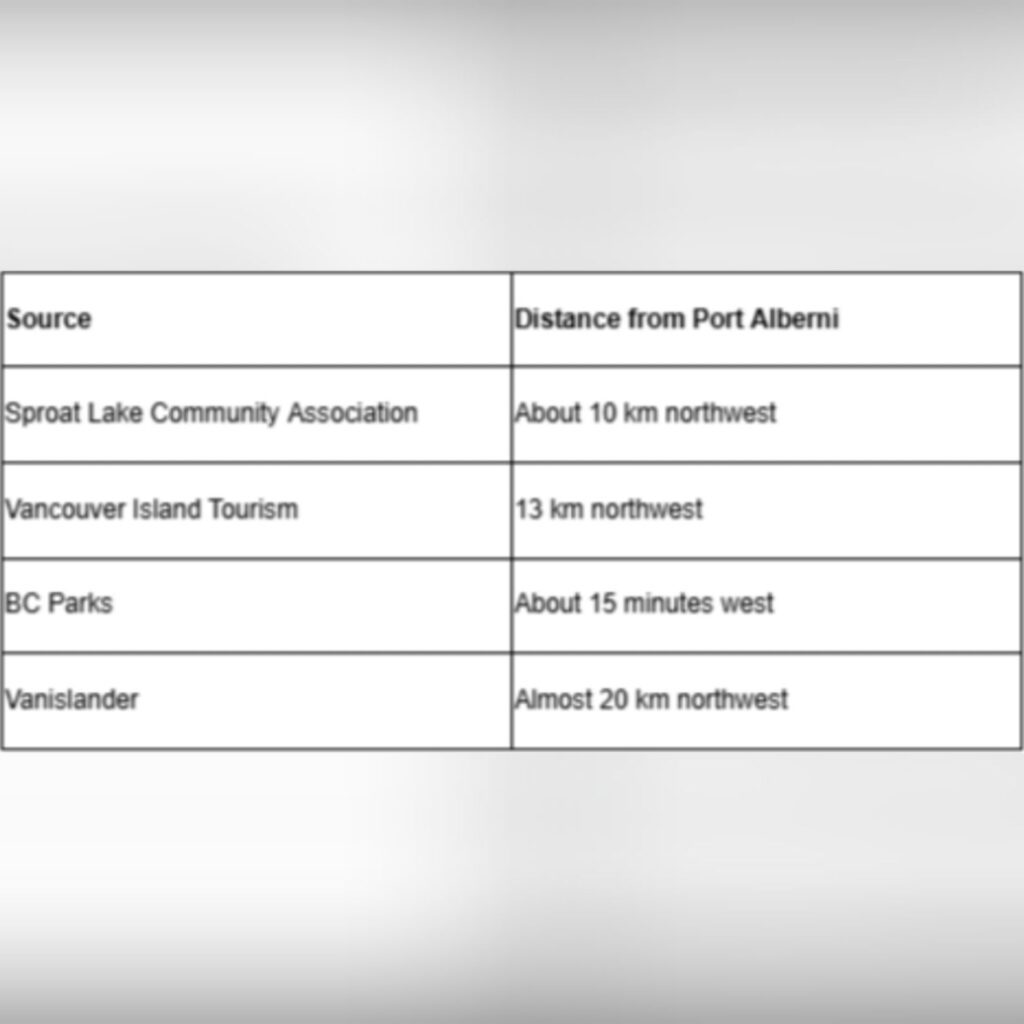
Head northwest from Port Alberni, in the middle of Vancouver Island, and the lake appears. Sources give different distances, and the gap between them is wide enough to confuse a first-time visitor.

The difference mostly comes down to where each source starts and stops measuring. The lake is long, so the nearest shoreline is much closer to town than the far end. The Community Association’s figure of about 10 km is the shortest of the four. For the provincial park specifically, BC Parks’ estimate of roughly 15 minutes by car is a sensible number to plan around.

Getting there from Highway 4

Head west out of Port Alberni on Highway 4, the Pacific Rim Highway, and watch for the turnoff to Sproat Lake Provincial Park on the north shore. The highway follows the lake for a good stretch on its way to Tofino and Ucluelet. That makes the park an easy stop on a longer drive to the coast, and plenty of people treat it exactly that way.

The signage is clear, but the road curves a lot through here and the turn comes up quickly. Ease off the speed once the lake comes into view on your left.

What are the K’ak’awin petroglyphs, and how old are they?

The K’ak’awin petroglyphs are figures carved into rock at the eastern end of Sproat Lake Provincial Park, and they’re thousands of years old. They are one of the main reasons people who’d otherwise just drive past the lake decide to pull over.

Petroglyphs are images cut or pecked into stone, not painted on. That means the light changes them a lot. Low, angled sun in the morning or late afternoon brings out the grooves. At midday, under flat overcast, they can be surprisingly hard to pick out. If the first look is a bit underwhelming, give your eyes a minute and move around to a different angle.

These carvings are a cultural site, not a photo prop. Look without touching, and don’t chalk or wet the rock to make the lines show up better. Both damage the surface over time.

Parking and the walk in

Park in the day-use lot, then follow the 0.5 km trail east along the lakeshore to a small pier at the park’s east end. The petroglyphs are at that eastern end.

Half a kilometre is a short, easy walk. It suits young kids and anyone who’s been in the car since Nanaimo. The path stays close to the water, so the walk itself is part of the visit: open views down the lake and, in summer, the sound of boats.

Wear shoes with some grip. Lakeside rock and roots get slick after rain, and on this side of the island rain is never far away.

Why so little public shoreline?

Much of the waterfront around Sproat Lake is privately owned, which is why the two provincial parks matter so much for public access. Cabins and homes line long stretches of the shore, and their docks and beaches belong to the owners.

That’s useful to know before you head out with a kayak or a picnic hoping to find a quiet pullout somewhere along the highway. The parks are where you can reliably get down to the water. Plan your swimming and kayak launching around them and you’ll avoid a frustrating loop of slowing down at every gap in the trees.

Who was the lake named after?

The lake takes its name from Gilbert Malcolm Sproat, a Scottish-born man who came to Vancouver Island in 1860 to set up a sawmill. That was the start of the logging and milling economy that shaped Port Alberni for generations.

Long before that, the lake had another name. Local Indigenous people called it Kleecoot.

It’s worth keeping both names in mind as you stand in front of the K’ak’awin carvings. The settler name is barely a century and a half old. The rock art on the shore is many times older than that.

The Martin Mars water bombers

The Martin Mars were huge flying boats converted into water bombers, and they were moored right on Sproat Lake, using the lake itself as their runway. For years they were one of the most recognisable sights in the area: enormous planes sitting on the water, then scooping it up to fight forest fires.

To learn more, go to the Coulson Flying Tankers Visitor Center on Cherry Creek Road. It runs guided tours in July and August, so a summer trip is the time to fit it in. The tours cover the aircraft and the firefighting work they did. They make a good counterweight to the quiet of the petroglyph trail if you’re travelling with someone who’s more interested in engines than ancient art.

Cherry Creek Road is on the Port Alberni side of the lake. That makes it easy to pair with the park in a single half-day outing.

Is Sproat Lake worth visiting outside summer?

Yes, and not only in July. The lake has something to offer in every season, though the mood shifts a lot. Summer is for swimming off the park beaches and long evenings on the lake. July and August also bring the Martin Mars tours, which is a good reason to aim for that window if the planes are on your list.

Winter is a different trip altogether. The boats thin out and the lake goes still and grey, making the area a quiet retreat, the kind of place for reading by a window or taking short walks between showers. The petroglyph trail is just as short in January as it is in July, and with fewer people around you’ll often have the carvings to yourself.

Spring and fall land somewhere in between, with milder crowds and changeable weather that can flip from sun to drizzle in an hour.

One practical tip for any season: before leaving Port Alberni, check the weather, then time your walk to the petroglyphs for early morning or late afternoon, when the low sun will make the carved lines far easier to see.

How Long Wound Care Takes for Acute Versus Chronic Wounds

A wound that’s healing on schedule tends to look a little different every few days. One that has stalled looks about the same in week five as it did in week two, and that sameness is the signal most people overlook.

Acute or Chronic: The Day-One Question

Every cut, burn, surgical incision or ulcer starts out as an acute wound. It becomes chronic when it stops following the expected sequence of healing. Calendar time is what moves it into the second category, so the useful habit is to note the date the wound appeared and check it against a few cutoffs.

The 2-to-4-Week and 4-to-6-Week Acute Windows

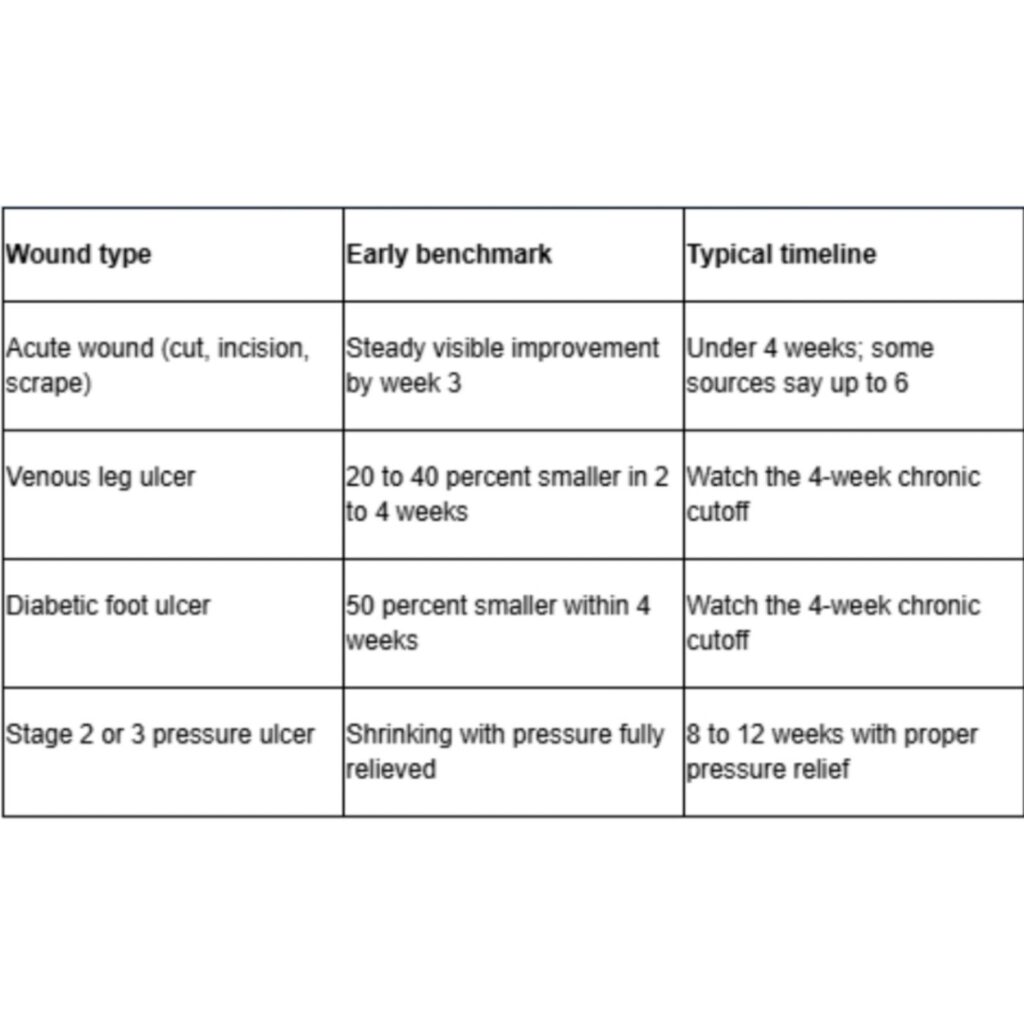
Acute wounds typically close in under four weeks when they move through the normal healing phases. Look a little further and the numbers start to wobble. Some sources put the normal window at 2 to 4 weeks, while others stretch it to 4 to 6 weeks. That disagreement gets more attention than it deserves, because a shallow scrape on a healthy forearm and a deep incision on an older adult’s shin will never run on the same clock, and no single number covers both. Trend matters more than the exact cutoff: is the wound getting smaller, shallower and less red each week?

Proliferation and Maturation Phases

Healing moves through overlapping stages, and two of them set most of the pace. The proliferation phase, when new tissue fills the wound bed and the edges pull inward, lasts about four days to three weeks. This is the visible part, where a wound goes from raw to pink and granular. Maturation comes next and runs much longer, anywhere from 21 days to a year.

During this phase, collagen remodeling strengthens the area. A closed wound can still be fragile months later, which is why a healed spot on the foot or heel deserves some protection well after the scab is gone.

The Day 21 Checkpoint

Three weeks is the most practical line to draw.

Anything that has not improved after three weeks should be evaluated at a wound care center. That timing makes sense. It falls at the far end of the proliferation phase, so a wound that hasn’t started filling in by then has already missed the stage where most of the visible progress happens.

Chronic Cutoffs at Four, Eight and Twelve Weeks

Definitions of a chronic wound vary, and it helps to know all of them:

Failure to heal within four weeks is commonly called chronic. Another definition uses eight weeks without significant improvement. Many sources describe chronic wounds as those still unhealed after 12 weeks, and some put it at three months.

The four-week definition is the one worth acting on. Waiting for the 12-week mark lets a stalled wound sit for two extra months before anyone changes the plan.

Measuring Wound Area in Weeks Two Through Four

Early shrinkage turns out to be one of the better predictors of eventual healing. For venous leg ulcers, a 20 to 40 percent reduction in wound area within 2 to 4 weeks points toward healing. For diabetic foot ulcers, the benchmark is a 50 percent reduction within the first four weeks.

Weekly photos with a ruler or coin in the frame make these numbers usable at home. Having that progress measured and recorded is straightforward at Sarasota Wound Care, where tracking the wound’s size from one visit to the next makes the percentage change easy to see and discuss. Clear measurements turn a vague sense that something “looks a bit better” into a number that can guide treatment.

Diabetic Foot, Venous Leg and Stage 2-3 Pressure Ulcers 

Pressure ulcers stand out here. Eight to twelve weeks is normal for them, but that range assumes the pressure is actually off the wound. A heel resting on a mattress all night can undo a day of good care.

Diabetic foot ulcers deserve the least patience of the group. Reduced sensation means a worsening wound can go unnoticed, so the four-week, 50 percent benchmark should be treated as firm.

First, Second and Third Steps in Sarasota

First, write down the date the wound started and take a measured photo today. Repeat it on the same day each week.

Second, compare against the cutoffs. Any wound with no improvement at three weeks, a diabetic foot ulcer that hasn’t shrunk by half at four weeks, or a venous ulcer that hasn’t reached a 20 percent reduction by then should be booked for evaluation.

Third, bring the photos and dates to the appointment, along with a list of medications and any conditions like diabetes or circulation problems. Specialists can work much faster with a clear record of how the wound has changed.

The 7 Best Car Lifts for Home Garage Setups, Ranked by Dealer-Grade Safety Standards

Dealer service bays follow the American National Standard ANSI/ALI ALOIM:2020, which mandates annual inspections by a qualified lift inspector. Lifts must be inspected at least once every year by a “qualified lift inspector” under ANSI/ALI ALOIM 2020.

Yet injuries still happen: U.S. OSHA records show more than 600 lift-related injuries are reported annually, underscoring the need for certified equipment.

Those numbers prove that playing by pro rules protects home-garage hobbyists as well.

How We Ranked the “Best Car Lift for Home Garage”

We compared 40+ models on six dealer-inspired metrics: ALI certification, load rating, ceiling fit, footprint, total cost of ownership, and real-world feedback from dealership techs. Two-post lifts remain the market’s fastest-growing product segment because they balance small footprints with dealership-level access.

The seven best car lifts for home garages below hit the safety marks while suiting very different garages.

1. Wrenchers-Sold BendPak GP-7 GrandPrix 2-Post Lift — Best Overall 

BendPak shrank its commercial XPR architecture into a homeowner-friendly footprint, and Wrenchers bundles the accessories you’d normally pay extra for. At 150 inches tall, it slides under a typical 13-foot ceiling yet still hoists 7,000 lb.

  • ALI Gold Label certified; meets the same structural tests as dealership lifts face.
  • GrandPrix single-piece columns resist 2x more torsion than bolted uprights.
  • Bi-Metric arms pivot 180° for a wide or narrow stance.
  • Powder-coat finish rated 1,000-hour salt-spray per ASTM B117.


Bottom line: If you want dealer-grade safety without pouring new footers, the Wrenchers GP-7 is the no-brainer first pick.

2. Triumph NSS-8 Four-Post Lift — Best Budget Storage & Service Combo

Need a lift that doubles as a parking deck? The NSS-8 lets you stack a weekend toy over the daily driver and costs less than most two-posts. Four columns also make it forgiving on imperfect slabs.

  • 8,000 lb capacity handles full-size pickups.
  • Includes drip trays and jack tray; no extra upsells.
  • Freestanding design—no anchors—so you can reposition later.
  • ALI/ETL electrical system with 110-V plug.

Add the optional caster kit and roll the whole rig out of the way when party season hits.

3. QuickJack 7000TL Portable Scissor — Best for Shared Driveways

Apartment dwellers and HOA members love the QuickJack: it stores in a closet yet lifts a C-Class in 60 seconds. The new TL chassis gives a full-time rise height without extension blocks.

  • 7,000 lb rating covers most crossovers.
  • 110-V, 12-V or 220-V power unit options.
  • Auto-locking mechanical bars engage every 3 inches.
  • Collapses to just 3 inches for under-bed storage.

If your driveway is your shop, nothing beats rolling the 7000TL out, wrenching, then sliding it back under the workbench.

4. Atlas LR-10K-LOW Low-Rise Pad Lift — Best for Sports Cars

Aero kits and side-skirt ground effects hate tall arms. The LR-10K-LOW’s rubber blocks start at just 2.75 inches, so even Miatas and GT3s glide on without ramp rub.

  • 10,000 lb capacity leaves headroom for SUVs later.
  • Dual scissors keep the platform dead-level.
  • Pneumatic safety locks release with a foot pedal.
  • Powder-coated steel lines resist brake-fluid corrosion.

Track-day enthusiasts can bolt it semi-permanently or leave it freestanding for quick garage re-configs.

5. Rotary SPOA10-TRIO — Best for Trucks & EV Battery Packs

Rotary’s Trio™ arms adapt from symmetric to asymmetric in seconds, critical for heavy front-biased EVs. The SPOA10 is a staple in Chevy and Ford dealers; the TRIO version brings that muscle home.

  • 10,000 lb capacity with 3-stage arms for long-wheelbase pickups.
  • Shockwave™ DC power unit lifts to full height in 30 seconds.
  • ALI Gold Label plus Rotary’s 5-year structural warranty.
  • Polymer pad adapters included for battery-pack skid plates.

Hauling an F-150 Lightning onto this lift feels exactly like a dealership bay—because it is.

6. Tuxedo TP-9KF-P Compact Parking Lift — Best for One-Car Garages

One bay, two cars—that’s the TP-9KF-P promise. Short runways and 103-inch posts fit where most parking lifts won’t.

  • 9,000 lb gross vehicle weight; 80-inch rise height.
  • Single-point pneumatic lock release—no crawling to each corner.
  • Drip trays keep upper-car oil off the resident below.
  • 115-V power pack draws less than a space heater.


City dwellers effectively double their square footage overnight.

7. APlusLift MT-1500X Motorcycle/ATV Lift — Best Multi-Toy Option

Cars aren’t the only machines that need safe elevation. The MT-1500X handles cruisers, sleds and even lawn tractors.

  • 1,500 lb capacity with 84-inch table length.
  • Front dropout panel speeds tire changes.
  • Detachable side extensions for ATVs.
  • Foot-pedal hydraulic pump keeps hands free.


A fold-away ramp and casters mean two-wheel tinkering never hogs the whole bay.

Ownership Cost & Maintenance Checklist

Budget 5% of the lift’s purchase price annually for inspections, replacement cables, and hydraulic fluid. Lifts must be inspected at least once every year by a “qualified lift inspector” under ANSI/ALI ALOIM 2020.

A one-hour Check360 inspection is cheaper than a single ER visit.

[For a deeper look at what can go wrong when lifts aren’t maintained, see AutoNews’ cautionary piece “failing to maintain lifts endangers employees, risks fines.”]

Caveats & Counterpoints

No lift can fix a thin slab. Verify 4-inch, 3,000-psi concrete before you buy; shim kits are not substitutes for strength. Plan a dedicated 20-A circuit for two posts.

Conclusion: Raising the Bar on Home-Garage Safety

Dealer-grade safety isn’t overkill; it’s peace of mind. Pair any of these “best car lift for home garage” picks with annual inspections and you’ll wrench smarter—and sleep easier—knowing pro-level engineering is holding the weight.

How Jury Research Is Changing High-Stakes Litigation

If you follow major legal disputes, you’ve probably noticed that courtroom strategy now starts long before opening statements. Lawyers are using more refined testing, better audience analysis, and faster feedback loops to predict how a case may land with real people. For complex civil and criminal matters, jury research has become a serious part of trial prep, shaping arguments, witness order, visuals, and even settlement pressure before a case ever reaches a verdict.

Why trial strategy now depends on audience testing

A strong legal argument can still fail if jurors don’t trust the messenger or can’t connect the facts into a clear story. That gap is where jury research has become far more influential. Trial teams no longer rely only on instinct from senior litigators who have “seen it all.” They test case themes, damages claims, witness impressions, and liability narratives with structured feedback.

When you look at how firms prepare today, the shift feels similar to how political campaigns use polling before a debate. In litigation, mock juries and focus groups reveal where confusion starts, what facts trigger skepticism, and which phrases sound evasive. A service like The Trial Concierge fits into that reality by helping legal teams evaluate how a case may actually play in front of decision-makers, not just how it reads in a brief.

What jury research actually looks like behind the scenes

A lot of people picture a mock trial as a watered-down courtroom performance. The real process is more technical than that. Depending on the case, researchers may recruit participants who match the venue’s jury pool, present condensed evidence, track reactions, and collect both qualitative and quantitative data. You’ll often see issue testing, witness scoring, deliberation analysis, and post-session debriefs.

For you as an observer, the interesting part is how granular this has become. Jurors may react differently to the same evidence depending on sequence, language, and visual framing. A damages chart that seems persuasive in chambers may look inflated to a lay audience. A polished executive witness may come off as rehearsed. Those details matter because verdict risk often turns on credibility architecture, not just raw facts.

How lawyers use findings without letting data run the whole case

Good trial lawyers don’t hand over strategy to a spreadsheet. They use jury research to pressure-test assumptions, not to replace legal judgment. If a mock panel dislikes a key witness, the answer isn’t always to hide that witness. Sometimes the move is tighter direct examination, cleaner document selection, or a more candid acknowledgment of weak facts before opposing counsel weaponizes them.

You can see the value most clearly in cases with technical subject matter. Patent disputes, mass tort claims, white-collar prosecutions, and catastrophic injury suits often involve dense records and jargon-heavy testimony. Research helps lawyers identify where simplification is essential and where oversimplification feels manipulative. It also shapes voir dire preparation by highlighting attitudes that may predict resistance, sympathy, or punitive leanings among jurors.

The settlement impact is bigger than most people realize

Jury research doesn’t only matter for the final trial presentation. It can change the economics of the case months earlier. When both sides get a clearer sense of verdict exposure, mediation posture often shifts. A defendant facing serious reputational facts may stop assuming that liability confusion will save them. A plaintiff with a weak causation story may rethink an unrealistic demand.

If you’re tracking litigation from a business angle, this is where things get especially practical. General counsel and insurers want numbers they can model. They care about risk bands, venue sensitivity, and likely juror reactions to corporate conduct. A carefully run mock exercise can expose whether a case is a manageable nuisance, a settlement candidate, or a trial that could produce a nuclear verdict. That kind of intelligence affects reserves, board reporting, and negotiation leverage.

Technology is making jury feedback faster and more precise

The newest development isn’t just that more teams use jury research. It’s that the methods are getting faster, more remote, and more data-rich. Online testing platforms, digital exhibit presentation, and rapid-turn feedback tools allow trial consultants to gather useful reactions without the scheduling burden of traditional in-person sessions for every matter. That matters when hearings move quickly, or budgets are tight.

Speed, though, doesn’t solve every problem. Remote research can miss some of the emotional dynamics that show up in live deliberation rooms. Nonverbal cues, group dominance, and fatigue patterns still matter. The strongest teams know when to use quick-turn online testing and when a full mock trial is worth the cost. Precision comes from matching the method to the stakes, the venue, and the complexity of the evidence.

What separates useful jury research from expensive theater

Not every exercise produces insight. Some become performative, with too much emphasis on slick presentation and not enough on case design. If the sample is poorly recruited, the facts are unrealistically edited, or the moderators push participants toward certain conclusions, the output can mislead everyone involved. That’s one reason experienced litigators care so much about methodology.

You should look for whether the process captures authentic reactions instead of confirming what the trial team already wants to believe. Reliable work usually includes balanced fact presentation, disciplined questioning, and careful attention to venue-specific attitudes. In a polarized environment, social identity, institutional trust, and class perceptions can influence verdicts in ways that old-school instincts miss. The point isn’t to manufacture a perfect story. It’s to understand what real jurors are likely to do with the one you have.

Why this matters beyond the courtroom

The broader implication is hard to ignore: modern litigation is becoming more audience-aware, more empirical, and more interdisciplinary. Trial lawyers still need command of evidence, procedure, and advocacy. They also need fluency in communication strategy, behavioral research, and decision science. Cases are increasingly won by the side that can translate complexity into credibility without insulting the intelligence of jurors.

For you, that means high-stakes trials are less mysterious than they appear from the outside. Verdicts don’t emerge from pure drama or legal genius alone. They’re shaped by preparation systems that test what people hear, doubt, remember, and repeat in deliberations. As jury research keeps evolving, expect trial strategy to keep moving toward sharper message discipline, earlier case assessment, and fewer assumptions left untested before the stakes become irreversible.

New Mexico Wholesale Cabinet Suppliers Compared by Style and Finish Options

Choosing a wholesale cabinet supplier comes down to far more than price. Style range, finish quality, lead times, and whether the supplier actually serves your region all shape whether a project finishes on schedule, or doesn’t. These five suppliers take genuinely different approaches, and which one fits depends on what you’re building and where you’re building it.

1. Highland Cabinetry

Highland Cabinetry screenshot

Highland Cabinetry is an RTA wholesale supplier built around volume, variety, and nationwide reach. Their catalog covers Shaker, Euro, and Nano door profiles in finishes that include White, Gray, Modern Slate, and Natural Walnut, a workable palette for both classic and contemporary builds. Contractors sourcing New Mexico wholesale cabinet options through Highland can draw on showroom locations in Albuquerque, Santa Fe, Rio Rancho, and Las Cruces, which makes in-person spec reviews possible before any order gets committed.

Standard features across the line include soft-close doors and drawers, dovetail drawer construction, and L-bracket reinforced framing designed to hold granite, cement, or stone countertops without flex. Highland stocks over 20,000 kitchens at any given time and manufactures more than 25,000 per month; even large, fast-moving projects rarely hit an inventory wall. Delivery averages 7 to 9 days nationwide. Every cabinet carries a lifetime warranty, and the company sells direct to builders, contractors, flippers, and cabinet suppliers, with a dealer program available for higher-volume accounts.

2. Trussell’s Transformations

Trussell’s Transformations is an Albuquerque-based general contractor that doubles as a local cabinet source, a practical setup for homeowners and small project teams who’d rather have design, product, and installation handled by one company. The firm has worked the Albuquerque and Rio Rancho area for over 25 years out of 8023 Edith Blvd NE, running a showroom where clients can browse cabinets alongside countertops, flooring, and roofing materials.

Their fabrication shop handles granite and quartz in-house, so cabinet and countertop selections get coordinated directly rather than through multiple vendors. Kitchen and bathroom remodels are the main focus, but the team takes on smaller jobs too, countertop swaps, cabinet updates, flooring installs, recessed lighting. Past clients consistently mention honesty and clear communication. Trussell’s is licensed and bonded.

But here’s the thing: with 1 to 10 employees, scheduling during busy seasons may require more lead time than you’d expect, and pricing isn’t publicly listed, so you’ll need to reach out for a quote.

3. Interiors

Interiors screenshot

PD Interiors operates as a luxury showroom and design resource in Albuquerque at 3800 Hawkins Street NE, primarily serving trade professionals – architects, designers, and remodeling contractors – who need to specify cabinetry alongside lighting, plumbing, and hardware in a single visit. The cabinet offering is brand-specific rather than house-label: the showroom carries lines from Bellmont, Fabuwood (Allure and Illume), Sollid (Three Series, Select Series, and Custom Series), Envii, Koville, Stoll, and Challenger. That breadth covers modern and traditional profiles across a range of construction-quality tiers.

PD Interiors pairs its product selection with design consultations and an e-commerce platform for trade accounts, which compresses the specification phase on complex projects. The trade-client focus means the experience is calibrated for professionals who already know what they need and want spec support, not a generalist contractor relationship. No pricing is published, and the showroom’s positioning skews toward higher-end project budgets. It’s less suited to volume or quick-turn wholesale purchasing; more appropriate for curated, design-led work where brand selection genuinely matters.

4. O’Neill Cabinetry

O’Neill Woodworking has run as a custom cabinet shop since 1982, founded by Sean O’Neill and based at 6220 Main Avenue in Orangevale, California. The shop serves the broader Sacramento region – from the Sierra Foothills through the Bay Area and Northern California wine country – and manufactures everything locally. Because each piece is built to order, the product range covers full home custom cabinetry, kitchen remodels, bathroom cabinetry, closet systems, and entertainment centers rather than any fixed catalog of SKUs.

More than 180 door styles are available, radius doors included, with dovetail drawer construction and soft-close hardware throughout. Water-based, low-chemical finishes get applied inside an in-house dust-free facility, which matters for consistency on painted and stained doors. And O’Neill sells factory-direct, so the distributor markup disappears entirely. Free on-site consultations and estimates are included. Production typically runs 6 to 8 weeks from final approval.

The catch is geography. The shop doesn’t operate showrooms or distribution points in New Mexico or other Southwest markets, so for anyone outside the Sacramento region, the footprint is a real constraint.

5. Cabinet Connection

Cabinet Connection screenshot

Cabinet Connection is a family-owned Albuquerque cabinet company founded in 1994, located at 2605 Princeton Dr NE. Three distinct paths to finished cabinetry are on offer: fully custom builds made from scratch to fit a specific space, prebuilt cabinets from established brands for faster timelines, and a full design-plus-installation service covering kitchens, bathrooms, and home offices. That range makes the company accessible to clients with firm budgets who want prebuilt speed and to those willing to wait longer for a custom result.

Mario and Mark run the business together and are reachable by individual phone lines, you’re dealing with the owners directly, not project managers relaying messages. Honestly, that tends to mean faster answers and more flexibility through the design phase; it’s one of the genuine advantages of a family-run operation. No pricing is publicly listed, and the company’s scale means it works best for residential projects and smaller commercial builds rather than high-volume wholesale accounts. So for local Albuquerque buyers who want personal attention from first consultation through final installation, it’s a strong fit.

Bottom Line

The right wholesale cabinet supplier depends on what a project actually needs. High-volume contractors working across the Southwest – needing consistent style options, fast delivery, and regional showroom access – are looking at a different answer than a homeowner doing a single kitchen remodel in Albuquerque. Locally focused operations like Trussell’s Transformations and Cabinet Connection offer hands-on service that larger wholesale suppliers don’t replicate, while PD Interiors suits trade professionals who need curated brand selection alongside design consultation. O’Neill Woodworking serves the Northern California market well but doesn’t reach the Southwest. For wholesale cabinet suppliers compared by style and finish options across multiple markets, volume capacity, warranty terms, and regional coverage all deserve real weight before any order gets placed.