360 MAGAZINE is an award-winning international publishing on popular culture and design. We introduce avant trademarks to efficacious architects.
We are a LGBTQIA2S+ friendly publication--officially recognized by the NGLCC.
Our core demographic ranges from 19 to 39-year-old college-educated trendsetters within their respective international communities. The pages in this art book satisfy their strong interests including music, art, travel, auto, health, fashion, tech, philanthropy, design, food and entrepreneurship.
It's an introspective digital/print/tablet portrait series, which encapsulates artists/brands/entities who embody the true essence of our publication- empowerment, equality, sensuality and most important of all, humanity within a global society.
Online gaming continues to move forward. That’s clearly evidenced in the world of digital casinos. No longer is it simply about recreating the traditional casino experience. Now, a newer generation of platforms are experimenting in different, exciting ways.
Whether it’s through original games or social features, the following standouts show how this new wave of online casino gaming is taking shape.
1. Duel
Visit Duel, and you’ll instantly see it’s a world apart from the polished, conventional casino model. Its rebellious identity – it self-identifies as the “first casino that gives a f*ck” – is matched by an emphasis on original games. Not just your run-of-the-mill titles, these originals include bizarre concepts like Groomer’s Van and Beef. The latter sees you guide a cow across a busy road in a crash-style game.
There’s substance behind the personality. Its originals feature a headline worthy 100% RTP, which means there’s zero edge for the house. No other casino can claim that right now. Then its provably fair mechanics provide greater transparency around game outcomes. Duel also puts its community at the center of the experience, with live chat and real-time bets allowing you to see what others are playing and interact around ongoing games.
With a combination of distinctive branding, unconventional games, and community features, Duel is the clearest example of the new wave in casino gaming.
2. Cloudbet
Cloudbet represents another key aspect of the newer crypto casino landscape: games built around exceptionally high theoretical returns. Its casino features a selection of original titles, with some of its offerings reaching around 99% RTP.
While not as high as Duel, that figure again changes the conversation around what players can find at an online casino. It’s no longer about competing through enormous game libraries and standard promotional features. High RTP games are another way for casinos to differentiate themselves.
Cloudbet also underlines the crypto-centric nature of this newer generation of platforms, where cryptocurrency isn’t an afterthought – it’s integrated directly into the gaming experience.
3. Yeet
Yeet takes the idea of casino gaming in a more social, unconventional direction. Some platforms present themselves as purely a traditional casino with cryptocurrency payments. Yeet highlights how it combines casino gaming with a stronger social and community-oriented identity.
When compared to a conventional casino lobby that includes thousands of slots and little else, its approach to crypto, social interaction, and original titles gives the platform a different feel. The emphasis at Yeet is simple: creating an environment around gaming. This isn’t simply a library of games to play.
4. Thrill
Thrill represents another side of the new crypto gaming landscape, putting more into the overall experience. Its original games, which include Limbo, Plinko, and Slide, feature games that are directly associated with the platform. These aren’t simply sourced from third-party providers.
Along with displaying bets in real time, the platform also uses an XP system that allows players to level up and earn bonuses. This creates a greater sense of activity around the games. No longer is each player treated as completely separate from everyone else.
As with Duel, Thrill combines its casino with sports betting, which creates a wider entertainment platform overall.
Buying a ring, a diamond, a custom piece — easier when you can actually see it. Hold it. Online listings give you measurements, photos, prices, certification details. Fine. But a physical store gives you craftsmanship up close. Side-by-side comparisons. Real questions, answered on the spot. Visiting a local jewelry store can also help buyers understand how different materials,
Engagement ring. Diamond. Wedding bands. Custom design. Whatever the goal, knowing what to look for makes the whole trip a lot more productive.
Start With Knowing What You Actually Want
Before walking in, have a rough idea. Not every technical detail — just your preferred metal, roughly your budget, stone shape, general style. That’s enough to narrow things down fast.
Someone shopping for an engagement ring might already know: round, oval, emerald, pear-shaped. Someone else might just want a simple gold band, or something custom carrying real personal meaning.
A clear starting point means comparing pieces on consistent criteria. Not getting pulled in ten directions by every shiny thing in the case.
Look at Jewelry Under Different Light
Lighting changes everything with diamonds and gemstones. Store displays use carefully positioned lighting — makes stones look bright, alive, better than they might elsewhere. Ask to see a piece under more than one type of light if possible. Worth the ask.
Look from different angles. Watch how the stone interacts with the setting. For diamonds — brightness, flashes of light, darker patches worth noticing. For colored gemstones — color consistency, transparency, visible inclusions.
Physical inspection catches what photos miss, too. Band thickness. Setting height. How the prongs actually hold the stone in place. Small stuff. Matters a lot.
Compare Materials and Craftsmanship, Not Just the Stone
Quality’s not just about the center stone. Metal, setting, finishing, construction — all of it shapes how a piece looks and holds up over years.
Ask what metal’s actually being used. Solid? Plated? An alloy? Gold comes in different karat levels — changes composition, color, durability, price, all at once. Platinum’s got its own physical characteristics, different from gold — worth considering if that’s the direction.
Check for smooth edges. Secure prongs. Even finishes. Clean alignment. On a ring, gently check how the stone actually sits in its setting. For custom pieces, ask how the design gets built. What steps happen before it’s actually finished and delivered.
Ask About the Actual Documentation
Buying a significant stone? Documentation matters. A diamond grading report covers carat weight, color, clarity, cut-related details — real info for real comparison.
Ask whether the stone comes with an independent grading report. Check the document actually matches the stone being shown — not always a given. For colored gemstones, documentation might cover treatments, origin, identification, depending on the stone itself.
Documentation isn’t just paperwork for the sake of paperwork. It’s information. Lets you compare stones on consistent characteristics instead of just trusting a sales pitch.
Pay Attention to the Actual Service
How a jeweler communicates matters just as much as what’s in the case. A good experience gives real time to examine pieces. Ask questions. No rush. No pressure.
Ask directly — sizing, resizing, warranties, maintenance, repairs, cleaning, return policy. Considering something custom? Ask about design revisions, production time, stone selection, what happens if changes come up mid-process.
Visiting Aura Diamonds or any other local jeweler — same basic questions work everywhere. Use them to make real comparisons between stores.
The goal’s gathering info. Not just sitting through a sales presentation. Clear answers tell you what’s actually included, and what costs extra on top.
Compare Selection — Not Just the Size of the Case
A huge display case doesn’t automatically mean a better selection for you specifically. Look at whether the styles actually match your preferences. Whether there’s real variety in stones and metals to compare.
Pay attention to shape variety, settings, band widths, metal colors, gemstone options, price ranges. A smaller selection can still work fine if it’s got what you’re actually looking for.
For custom jewelry, “selection” means something different too — access to stones, settings, design possibilities. Not just finished pieces sitting under glass.
Understand What You’re Actually Paying For
Price only means something next to the actual specs. Two rings that look nearly identical can differ wildly in diamond characteristics, metal purity, craftsmanship, included services.
Ask whether the price covers the center stone, the setting, taxes, sizing, engraving, whatever else. For custom pieces, get a clear breakdown of major components before approving anything.
Helps to compare several pieces within a similar budget too. Makes it obvious how stone size, quality, metal, and design each move the final price.
Take Your Time. Seriously
Doesn’t need to happen in one visit. Take notes on what you liked. Record specs where allowed. Compare everything after you’ve actually left the store, with a clear head.
Buying an engagement ring or custom piece? Think about how it fits everyday life, not just how it looks under showroom lighting. A ring that looks incredible in the case should also feel comfortable. Practical. Every day, not just the one day you tried it on.
Visiting a physical store turns an online search into something hands-on. Real comparison. Examine the craftsmanship. Check the documentation. Ask the real service questions. Compare materials. Understand the pricing. Put it all together, and the whole search gets a lot more organized. A lot more informed.
Major weight loss may lead to an unexpected emotional shift, especially when you are planning to re-enter professional environments with a transformed body. The biggest challenge lies between wearing ill-fitting old clothes and investing in a new wardrobe while your body is still changing.
Rebuilding a professional wardrobe is not only about clothing, but it is also about an investment in career confidence and an important step towards embracing your new lifestyle. With the right essentials in your wardrobe, you will feel empowered to project the success and vitality that reflect your weight loss journey and your commitment to long-term health goals.
Mastering the Art of Transitional Professional Style
Major weight loss is often connected with the use of medical weight loss drugs such as Wegovy, Ozempic, and generic semaglutide. These medications can significantly alter your body shape over time, which makes rebuilding a professional wardrobe both exciting and challenging.
The “In-Between” Phase: Dressing up professionally during this phase requires flexible wardrobe choices. Opting for pieces that accommodate gradual size changes without compromising style can be a great idea. For example, you can pick wrap dresses or adjustable waistbands.
The Power of Alterations: If you do not wish to give away the collection already present in your wardrobe, investing in a skilled tailor can go way beyond what you think. A skilled tailor can adjust blazers, trousers, and structured garments by a few sizes. This practice not only saves money but ensures a polished fit throughout your weight management journey.
Focusing on Accessories: Accessories are key to maintaining a sophisticated look without depending on size-specific items.
Choose statement luxury belts as they can cinch looser silhouettes and add definition to your look.
To elevate your professional outfit, you can carry a structured leather bag and wear premium footwear.
Besides that, you can also include classic timepieces and minimalist jewelry, as they provide timeless elegance and help you create a polished overall appearance.
Smart Budgeting Strategies for Your New Work Wardrobe
In this regard, understanding your financial reality is crucial because completely replacing your wardrobe all at once may not be a sustainable option.
This is where Capsule Wardrobe Methodology comes into the picture, which emphasizes picking a compact collection of versatile yet neutral pieces that you can mix and match easily. The approach helps maximize your outfit options without breaking your bank while ensuring flexibility during your weight loss journey.
Embracing Pre-Owned Luxury and Consignment
If you are looking for a luxury collection, navigating the resale market can be a good option. In the resale market, you will find premium consignment, high-quality, structured corporate wear at huge discounts. This practice not only saves money, but also makes sure that your professional presence remains polished.
Utilizing Clothing Rental Services for Executive Wear
During your weight management program, you are supposed to adjust your budget to stick to a specific Ozempic meal plan, going to the gym, buying weight loss medications, and other necessities. Therefore, spending a great deal on building a new professional wardrobe is not a good idea.
This is the reason why most professionals rely on subscription-based rental services that offer access to high-end professional styles without long-term commitment. In short, clothing rental services are perfect for important meetings or presentations.
Essential Core Silhouettes for Your Permanent Corporate Look
Individuals who are prescribed weight loss medications may experience muscle loss in addition to fat loss. This is why fashion consultants recommend updating your wardrobe after muscle loss from Ozempic to create a structured and polished look.
Unstructured Blazer: Pick tailored shoulders with a forgiving torso fit.
High-Waisted Wide-Leg Trousers: Such trousers elongate and anchor your silhouette.
Classic Wrap Dress: Timeless, adjustable, and adaptable.
Timeless Jewelry: Complete your look with subtle accessories to enhance your refreshed look.
Actionable Takeaway:
Rebuilding a professional wardrobe after medical weight loss is both challenging and exciting. You can begin by evaluating your current wardrobe and choosing a few versatile, timeless pieces. Make sure you embrace this transformation as a reflection of your commitment to health and a better version of you, which can help create lasting vitality in your career.
THE RISING ARTIST JORJIANA MAKES HER PDF RUNWAY DEBUT, LAUNCHES A SPECIAL SUPPLIER EARTH AND GIO FORBICE COLLABORATION, TEAMS UP WITH SPICIE BRAND
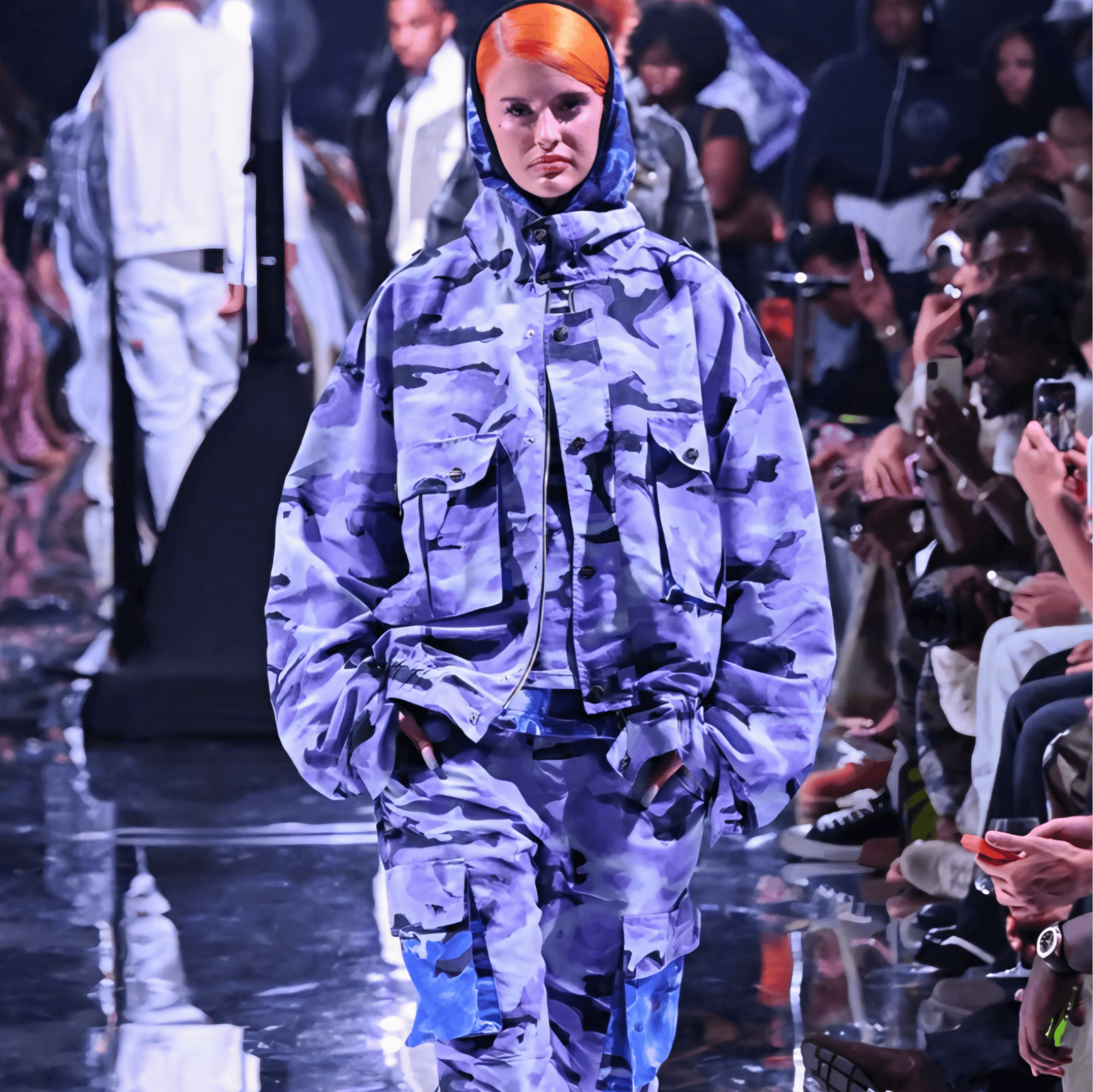
Jorjiana made a statement at New York Fashion Week this season, bringing her signature style and bold new era to the city with a week filled with runway appearances, fashion collaborations, and pop-ups.
Jorjiana took to the runway for PDF, making a memorable appearance in the designer’s first NYFW show, exclusively styled by Lil Yachty. In conjunction with her modeling debut, she attended high-profile shows of emerging designers such asKim Shui, RIO, and FANG. She also popped into several of the week’s best parties, from Bvlgari’s high-profile Serpenti Infinito launch party at The Standard’s BOOM to the private Mowalola x Jordan Brand collaboration celebration.
Continuing her NYFW takeover, Jorjiana hosted the Spicie Brand pop-up in partnership with the Bowery Showroom alongside internet sensation Thickneyy, where she got to engage with her fans. Lastly, ending the season on a high note, Jorjiana celebrated the launch of her first limited-edition collaboration with Supplier Earth and designer Gio Forbice by hosting a special one-day-only shopping event in the heart of New York. This marked the first introduction of a special iteration of the Art.002 Flip Flops 55mm kitten heel in her signature orange colorway. Designed to complement her current iconic statement hair, the exclusive style brings her distinct aesthetic directly into the world of fashion. Attendees had the opportunity to check out the collaboration firsthand.
Fresh off the release of her 5 Elements EP, Jorjiana continues to carve out her own space at the intersection of music, fashion, and culture. From making her mark on the runway to partnering with the top-tier designers and attending the most exclusive events, Jorjiana’s time during New York Fashion Week solidified the momentum of her evolution while bringing new excitement to everything she has on the horizon.
JORJIANA STUNS AT NEW YORK FASHION WEEK photographed by Hydeeah” Common” Johnson via 360 MAGAZINE.
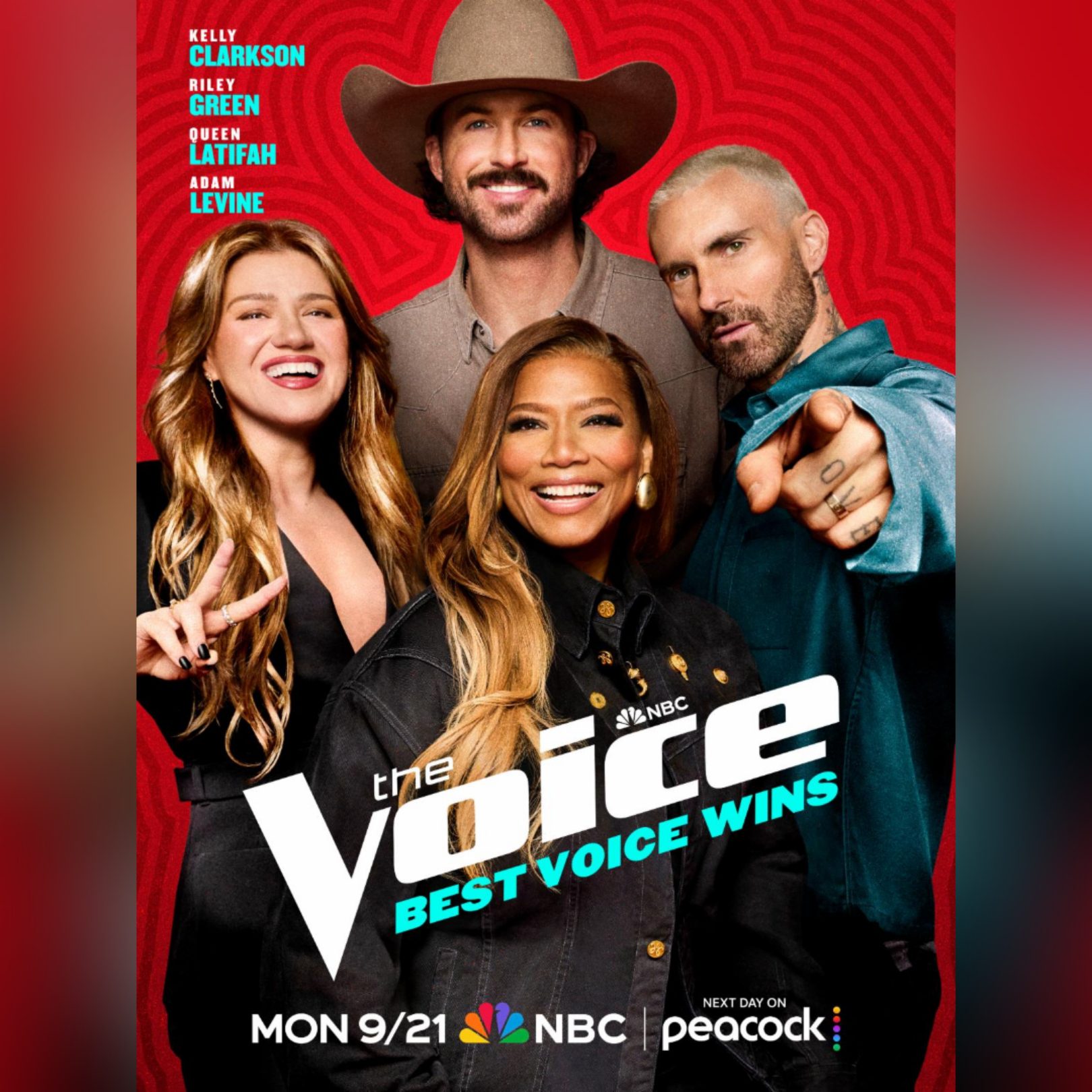
The four-time Emmy Award-winning musical competition series “The Voice” returns for a milestone Season 30 with the strongest vocalists from across the country invited to compete in the show’s newest season on Sept. 21. Prior to the premiere, “The Voice: 30th Season Celebration” kicks off the festivities on September 17 with host Carson Daly sitting down with coaches past and present – from beloved O.G.’s Blake Shelton, Adam Levine and CeeLo Green to fan favorites Kelly Clarkson and Gwen Stefani, along with newest coaches Queen Latifah and Riley Green – to look back on the evolution of the longstanding music competition and tease the upcoming landmark season.
The competition is fierce as music icon Queen Latifah and country superstar Riley Green step in the red chairs for the first time, alongside veteran coaches Kelly Clarkson and Adam Levine as they all vie to discover the next singing phenomenon. This powerhouse coaching panel aim to discover and coach the next singing phenomenon.
The show’s innovative format features four stages of competition: Blind Auditions, Battle Rounds, Cut Week, and Live Performance Shows.
During the Blind Auditions, the decisions the coaches make are based solely on voice and not looks as the coaches build their teams of 12 artists. The coaches hear the artists perform without getting to see them, thanks to rotating chairs. If a coach is impressed by the artist’s voice, they push a button to select the artist for their team. At this point, the coach’s chair will swivel so that they can face the artist they selected. If more than one coach pushes the button, the power then shifts to the artists to choose which coach they want to work with. If no one pushes their button, the artist is eliminated from the competition.
New this season is the “First In Button,” taking the competition to new heights during the Blind Auditions. If multiple coaches turn at once, the coach who turned first can press their button before the artist’s decision and claim that artist. This button can only be used once.
Once the teams are set, the battle is on. This season, the coaches are each enlisting a superstar Battle Advisor to help guide their teams as they compete to make it through the Battle Rounds on to Cut Week. During the Battle Rounds, two team members compete against each other by singing the same song together. Coaches will pick the battle pairings and songs and each coach will have one “Steal” to use in the battles.
It’s the biggest elimination in “Voice” history when Cut Week arrives. For the first time ever, each coach will send two artists straight through to the Live Shows, while five more battle for one remaining spot on their team. Once the top 12 is set, America votes one final additional artist into the Lives, solidifying the Top 13.
Starting with Cut Week, America will get to choose the 13th artist to advance to the Live Shows with brand-new voting through SMS and on TikTok. Fans won’t have to wait for long to know who’s moving on either, as real time voting makes a return starting with Live Shows and results being announced the same night.
The Live Performance Shows is a six week event, starting with the top 13 artists performing. The television audience will vote starting at the top of the show for their favorite artists through SMS or TikTok. Those with the lowest number of votes will be sent home and one artist will be named “The Voice.”
“The Voice” is a presentation of MGM Alternative, a division of Amazon MGM Studios, Warner Horizon Unscripted Television, a Warner Bros. Television Group company, and ITV Studios The Voice USA, Inc. The series was created by John de Mol, who serves as an executive producer along with Mark Burnett, Audrey Morrissey, Amanda Zucker, Kyra Thompson, Adam H. Sher and Barry Poznick.
Most riders assume insurance just works the same way it does for a car, pay the premium, get in a crash, file a claim, get taken care of. It feels like a fairly settled expectation, the kind nobody really questions until they actually need to rely on it.
Then a crash happens, and suddenly that assumption gets tested against the actual fine print of a policy nobody read too closely. Limits turn out lower than expected. Certain things aren’t covered at all. What felt automatic turns out to have been considerably more conditional than anyone realized.
That gap between assumption and reality is exactly why decoding Florida motorcycle insurance requirements before an accident matters so much more than trying to make sense of it afterward, while injuries and bills are already piling up.
The Car Insurance Assumption
A lot of riders come to motorcycles after years of driving cars, carrying over assumptions built around auto insurance without really questioning whether those assumptions actually transfer cleanly. On paper, it seems reasonable, insurance is insurance, right?
Not quite. Motorcycle coverage often operates under different requirements and different typical policy structures than standard auto insurance does. What’s mandatory for a car isn’t necessarily mandatory for a bike, and vice versa, depending on the specific state and situation involved.
That mismatch between expectation and actual policy structure is where riders frequently get caught off guard, discovering the hard way that motorcycle coverage was never quite the same animal as what they’d grown used to carrying on four wheels.
The Coverage You Thought You Had
Policy limits matter enormously here, since a limit that sounded reasonable at the time of purchase can turn out to be genuinely inadequate once real medical costs and lost income actually enter the picture following a serious crash.
Exclusions deserve attention too, certain situations or types of damage that a policy simply doesn’t cover, buried in language most people skim right past when they’re just trying to get insured and move on with their day.
Optional coverage adds another layer of complexity, since riders sometimes decline add-ons that would have meaningfully helped later, not realizing at the time just how much those additional protections might eventually matter after a serious accident.
When the Other Driver Doesn’t Have Enough
Even a rider with solid coverage can run into trouble if the at-fault driver doesn’t carry enough insurance themselves. Motorcycle injuries tend to be severe, and a driver’s minimal liability coverage often falls well short of what those injuries actually cost.
That gap creates a genuinely uncomfortable financial situation, where the rider did everything right, carried appropriate coverage, rode responsibly, and still ends up facing costs that outpace what the responsible party’s insurance can actually provide toward compensation.
This is exactly the kind of scenario uninsured and underinsured motorist coverage exists to address, though plenty of riders never think to add it until they’re staring down a shortfall that coverage could have prevented from the start.
The Worst Time to Read Your Policy
Reading through an insurance policy for the first time while sitting in a hospital bed is a genuinely rough way to discover a coverage gap. Everything that felt like a minor detail during purchase suddenly matters enormously, and there’s no going back to fix it now.
Plenty of these gaps would have been inexpensive, sometimes just a small monthly premium difference, to address ahead of time. A slightly higher policy limit, an added layer of uninsured motorist protection, none of it dramatic, but all of it meaningful in hindsight.
That’s really the core frustration here, the fixes were available and affordable beforehand, but nobody thought to look until the exact moment when looking no longer changes anything about the coverage actually in place.
Conclusion
Knowing exactly what protection exists before ever swinging a leg over the bike matters enormously more than discovering the answer for the first time while dealing with injuries, missed work, and mounting bills all at once.
Understanding policy limits, exclusions, and the real gap that can exist when another driver is underinsured helps riders make informed choices while there’s still time to actually adjust coverage rather than simply hope for the best.
A little bit of attention to the fine print beforehand can spare a rider from the genuinely unpleasant experience of learning about coverage gaps at the exact moment they matter most.
Mary J. Blige: My Life, My Story The Las Vegas Residency Kicked Off This Past May And Has 10 Dates Remaining In October 2026 And February 2027
GRAMMY and Emmy award-winning and Oscar-nominated, “Queen of Hip-Hop Soul,” Mary J. Blige, has announced her first Las Vegas residency at Dolby Live at Park MGM will end after an electric 20 date run, concluding in February 2027. Mary J. Blige: My Life, My Story The Las Vegas Residency still has 10 dates remaining, all happening in October 2026 and February 2027, including Halloween, Valentine’s Day Weekend and President’s Day Weekend.
“This residency felt like divine timing,” said Mary J. Blige. “I’ve seen so many of you in Vegas and we still have 10-dates left. I feel even more grateful and deeply inspired after every show. Grab your girlfriends, your boots, and I’ll see you in Vegas in October and February.”
Organizing a corporate golf Melbourne event involves more than simply booking tee times. The right venue can bring together golf, dining, networking and presentations, creating a full-day experience for colleagues, clients or business partners.
Choose a Venue That Fits the Day
Start by considering what you want the event to achieve. A small group may be looking for a relaxed round of golf and lunch, while a larger business event might require catering, competitions and space for presentations.
Sanctuary Lakes Golf Club in Point Cook offers an 18-hole Greg Norman-designed championship course, along with a driving range, clubhouse and function facilities. Its corporate golf packages can include 9 or 18 holes, golf carts, catering, on-course competitions and presentation support.
Make Time for Networking
One of the practical benefits of a golf day is that conversations can happen naturally throughout the event. Participants can connect between holes, during meals or after the round, without the formal structure of a traditional business meeting.
For companies planning an event in Melbourne’s west, having golf and function facilities at the same venue can also simplify the organisation.
Consider the Details
Before confirming a corporate golf day, think about the number of guests, playing format, catering, equipment and any presentations or competitions you would like to include.
A venue that can support these different requirements can make the day easier to coordinate.
Sanctuary Lakes Golf Club provides corporate golf and function options in Point Cook, offering businesses an alternative setting for bringing teams, clients and professional contacts together.
Malaysian Fan Turned Industry Leader: Chern Xin’s Success Behind Bruno Mars and Charli xcx’s Viral Campaigns
Growing up in Malaysia, her obsession with pop culture didn’t just stay a hobby. After making the leap from Kuala Lumpur to the United States for college, she set out to turn that deep fan intuition into a professional career. Today, Chern Xin serves as a Digital Marketer at Atlantic Records, standing directly behind the digital engine of this year’s biggest album rollouts.
“Being a music fan myself has given me direct insight into what audiences actually want to engage with. It is the best research strategy – I know what makes the general public care.”
That leap of faith paid off. Today, Chern Xin spearheads digital at Atlantic Records – the #2 ranked U.S. record label – where she blends her relentless drive with a deep understanding of fan culture to lead innovative digital strategies across major album rollouts, tour cycles, and emerging artist campaigns.
Going from professional swimmer to music industry leader wasn’t just a career change—it was a transfer of energy. The same mental endurance and discipline that once drove Chern Xin through years of competitive training now powers her work on fast-moving rollouts.
Through sourcing creators, building owned and operated fan page communities, and leading teams, she’s had the opportunity to work with some of the largest music artists and build their careers. When asked about her approach to tackling new campaigns, Chern Xin focuses on in-person creator collabs with the artists to engrain them in pop culture as well as live activations. It’s about fan engagement and building a world. To name a few talent, Chern Xin, worked across Bruno Mars’s latest project, The Romantic, Charli XCX’s, Music, Fashion, Film, and Miley Cyrus’s, Bass Persuades. The results speak for themselves with Bruno’s lead single and album hitting No. 1 on the Billboard charts and Charli’s debuting at No. 3.
As for what’s next for her – Chern Xin continues to elevate digital in the industry and remains a true pop culture stan. She is currently working on the viral campaign for BLACKPINK’s ROSÉ’s single “new trick” and we’re excited to see the reaction of the song online.
Culture merch rarely fails because the graphic is ugly. It fails because the first file that goes to a factory is a look, and the first object that comes back is a garment. Those are different jobs. Before a label briefs a custom streetwear manufacturer, someone on the drop team should write down which decisions the starting file can actually carry, and which ones are still open. Otherwise the sample becomes a pretty argument instead of a recorded standard.
A tour tee, a capsule with a museum partner, or a one-week pop drop usually begins as a render, a sketch pile, or a reference garment borrowed from last season. Each of those inputs is useful. None of them is a complete production brief. The missing pieces are ordinary: a back view, a fabric direction, a measurement, a usable artwork file, a packing note. If those gaps stay unnamed, the factory fills them in order to cut a first sample, and the talent later treats those fills as mistakes.
Jiashun Clothing builds men’s streetwear from a tech pack, a reference, a sample or a sketch, then quotes after review. New styles normally use a paid sample for fit, fabric, artwork and quality, with bulk following buyer approval. The claim worth testing on a culture calendar is narrower than “can they copy the mood.” It is whether the first sample can be given a version name, a written review, and the same identity as the specification that will run.
What The First Sample Is Actually For
The sample is not a souvenir of the concept. It is the first time the brief can be measured, handled and compared. Until that object exists, the team is still arguing about a picture. After it exists, the team can accept points, require changes, and keep those comments tied to one sample version instead of a chat scroll.
On a culture drop that is the difference between a reprintable garment and a one-off that cannot be reordered when the first size run sells. If the approved object and the written specification do not share a revision identity, the next carton will be negotiated again from memory, usually after the artist’s manager joins the thread.
The factory’s published sample window for simple work is typically 10–18 working days after project details are confirmed; complex styles take longer. Those days only answer a real question if the brief arriving on day one already names the open decisions. Sending a beautiful render and then discovering the neck rib on day sixteen usually means an unnamed field waited until cloth made it expensive.
What To Send Before Anyone Quotes
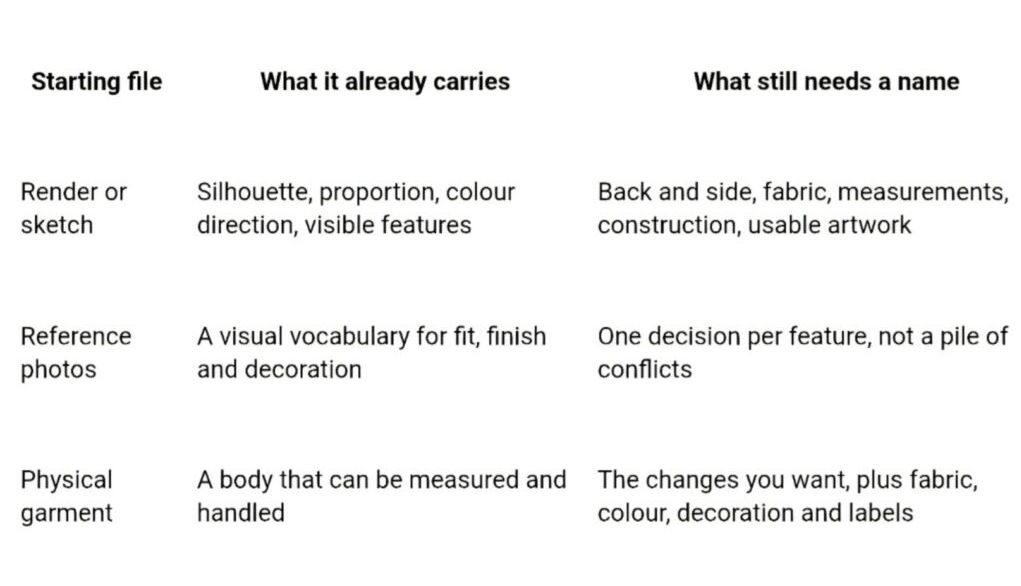
A tech pack helps and is not required. The intake can start from an AI render, a sketch, labelled reference images or a physical garment. What changes is not politeness. What changes is the list of facts the file cannot carry. Write that list in the same note as the file. The review then prices one project, not three competing guesses.
The inquiry form accepts PDF, PNG, JPG, WEBP, ZIP, RAR, AI, DOCX or XLSX, up to three files and 20 MB each. That cap is a planning fact, not a suggestion to dump a drive. Pick the files that settle silhouette, artwork and any measurement you already know. Leave the rest as labelled gaps. Vector artwork is preferred when it exists; a high-resolution flat and a placement mockup still help when the vector is not ready.
The table is a briefing aid. A culture team can start without a full tech pack. What it cannot do is pretend a front-view render already includes a back neck and a care label.
Render Sketch Or Labelled Reference Images
A render is strong on attitude and weak on construction. It can show a dropped shoulder and a chest mark. It cannot tell a cutter how the shoulder was drafted, what the fabric weighs, or whether the mark is screen print or a transfer. If the only file is a render, mark the details that must stay and attach any garment that explains the handfeel you want. Do not attach five conflicting street photos and call the pile “direction.”
Reference images work when each image is labelled. One photo for fit. One for fabric face. One for the graphic. When the same board asks for a tight rib and a stretched rib, the sample will invent a third rib. That invention looks fine in a preview until someone holds it next to the original reference and the neck no longer matches the campaign still. The fail is observable: the object and the picture tell different stories.
A Physical Garment Already In Hand
A garment you can photograph and measure is the cleanest start when the drop is “last year’s tee, new mark.” It already contains a fit and a construction. What it does not contain is the list of changes. Write those changes before the parcel moves. If the old tee is the fit and the new art is the product, say so. If the old tee is only a colour hint, say that too. An unlabelled vintage piece becomes a second brief hiding inside the first.
Jiashun Clothing can review that package. It cannot infer which seams were luck and which seams are the brand. The person who owns the drop has to mark the difference. A wasted afternoon usually begins here: the sample copies a hem the team never meant to keep, and the calendar has already spent the simple-sample window on the wrong question.
How The Sample Path Reaches Shipment
Once the starting file and the open decisions sit in one note, the published path is short. Keep it as four jobs, not as a mood. Each job should leave a sentence the next job can protect.
1. Send the brief. Share product type, quantity, fabric, artwork and a target delivery. A quote follows review, not a homepage form submission. Attach what you have; name what you do not.
2. Approve the sample. After details are confirmed, a simple sample typically takes 10–18 working days. Complex work takes longer. New styles are normally paid. The tee path uses the real fabric, print method and labels, so the object you approve is the object bulk is supposed to follow.
3. Run bulk production. After sample approval, typical bulk sits in a 20–30 working-day window, with materials confirmed. Cut, sew, decorate and review against the approved reference, not against a newer chat image.
4. Finish checks and shipping. Measurements, stitching, artwork, trims, labels and surface are checked against that same standard. Packing — fold, polybag, hang tag, carton mark — is part of the handover, not a later favour. Timing and method are confirmed by destination.
A custom t shirt manufacturer on this path is useful when the drop is a real tee with a real neck label, not a digital mock worn once in a lookbook. Screen print still suits bold flat graphics; DTG still suits detailed or high-colour work on compatible cotton. Those names only matter after the artwork and the fabric sit in the same sentence. Choosing a method from a menu, then discovering the fabric later, is how a sample gets built twice.
Errors That Burn The Sample Calendar
Most delays on this path come from brief errors that spend the 10–18 working days answering the wrong question. The cost shows up as a second paid sample, a missed drop week, and a manager who now thinks the garment “changed” when the brief never held still.
Conflicting References Waste The Sample Window
Two fits in one folder will not average into a third fit the talent likes. They will produce a sample that matches neither, plus a comment thread that tries to recover both. Label a primary fit reference and demote the rest to colour or graphic only. If the team cannot pick a primary, the sample is early. Sending it anyway trades a cheap argument today for a rework after cloth is cut.
The same rule applies to artwork. A campaign still, a logo file and a phone crop of last year’s print are three different marks. Pick the file that must survive at production size. Vector helps because it keeps edges usable when the mark moves from a phone screen to a chest. If the only file is a soft crop, say that the edge quality is still open. Do not approve a soft crop as if it were a production file.
A Chat Photo Is Not Sample Approval
A photograph of a sample on a hotel bed is a travel note. It is not a revision record. Fit, measurements, workmanship, artwork placement, trims, labels and packing direction belong in one written review tied to a version name. Separate accepted points from required changes. Add a marked image when a measurement is easier to see than to describe.
If approval lives only in a voice note, the next size run has no object to copy. The garment that looked fine in the hotel light can still be unreadable at the neck or wrong in the sleeve once it sits next to the original spec. That single discard should happen on the sample, in writing, not after five hundred pieces have already been sewn. A comment that never names the version is a comment that cannot be reopened without starting over.
What Must Be Locked Before Bulk Starts
Before bulk, the project record should hold the same identity on both sides of the table: the approved sample version and the written specification. Then lock quantity, size and colour breakdown, materials, timing, checking points, packing and shipping. Jiashun Clothing treats that cluster as the order plan. If any line is still a vibe, bulk will invent a number and the drop team will call the invention a surprise.
For a tee, complete the object the audience will actually handle. Neck labels, care labels, hem tags and hang tags are part of the sample, not a later print job. A culture drop that photographs well on a body and arrives in a blank polybag has finished only half the product. The unboxing is part of the release. If the tag copy, the care line and the bag mark are unnamed, they will be filled with whatever was on the line that week.
Weight is one number, not the whole brief. A heavyweight boxy tee in the 250–300 gsm band behaves differently from a lighter merch jersey; the sample should carry the knit you intend to sell, not a stand-in. Share a target handfeel or a reference tee if you have one. Approve after washing if the drop will be washed by customers, because rib recovery and body length can move. Do not lock a pre-wash chest and then argue with the post-wash body.
Payment, when the order is real, is bank transfer or Wise against a pro forma issued after details are confirmed. Terms sit on the quotation and invoice, and should not be the first time the budget owner sees the quantity they approved on a voice note.
Where This Path Still Leaves Work
The path does not replace a designer or a merch manager. It will not guess a missing back view, invent licensed artwork the team does not own, or turn a render into a guaranteed retail fit. International shipping time sits outside the 20–30 working-day production window and is confirmed by destination. If the drop date was printed before the brief was complete, the calendar—not the factory floor—is the constraint.
Keep The Dated Sample Not The Mood File
This route fits a culture team that can name a starting file, list the open decisions, and give the first sample a version. Jiashun Clothing can develop that sample from an incomplete creative pack and then run bulk against the approved pair of object plus writing. It is a poor fit for a campaign that only needs a digital still and has no plan to repeat the garment.
Arrive with one primary reference, the artwork that must survive, and the packing the audience will see. Leave with a dated sample and a specification that share a name. The useful outcome is a garment the next size run can copy, not a prettier file in the shared drive.