


Spanning Six Decades of the Nationally Acclaimed Artist’s Work
The world premiere of Revelations: The Art of Leo Twiggs spans six decades of work by the nationally acclaimed artist and is the first major retrospective exhibition in his home state of South Carolina. On view at the Gibbes Museum of Art (Jan. 30 – May 3), with more than 40 works created by Twiggs between 1961 and 2020, this exhibition marks the 50th anniversary of Dr. Twiggs’ landmark solo show at the Gibbes in 1976 (during the bicentennial year). A half-century later, this new exhibition comes at a national crossroads as America commemorates its 250th anniversary. Twiggs was born in 1934, just 45 miles from Charleston, and will be celebrating his 92nd birthday during the run of the exhibition.
The award-winning artist has created an indelible impact on American art in unprecedented ways. Most of the works on view are emblematic of the artist’s signature prowess in batik artmaking, a multi-layered and arduous wax-resist dyeing process. The deep saturation of colors onto cotton reflects his subject matter’s gravity and historic undertones, often intertwined with his prevailing messages of hope.
“The whole point is that we are all on this boat together. We either sink, or we swim by making this experiment work. At this 250th anniversary, when we have come so far together in this country, this retrospective is not just about me — it’s about us, our shared American experience,” says Dr. Leo Twiggs. “I like to create questions with my work, which weaves in and out of this American narrative. And you cannot pass through the 250 years of American history without passing through Charleston. Forty percent of the slaves that came into this country arrived through Charleston, and seventy percent of African Americans can trace their roots back to Charleston.”
A full-color catalogue accompanies the exhibition, and describes in a powerful way the artwork entitled Conversation (shown above). In the catalogue, the guest curator Dr. Frank Martin writes: “This conversation is between two individuals covered in signs and signifiers, indicating likely polemical differences in their points of view. Twiggs’ painting is a reminder that the hope of our democratic republic is grounded in our capacity to sustain a discourse of oppositional, dialectical exchange as a national strength.”
The museum has created a robust series of programs surrounding this exhibition, for the public to enjoy.
View the schedule of programming + events HERE.
The Gibbes Museum invited Dr. Frank Martin to guest-curate the exhibition, working in tandem with Sara Arnold, the Gibbes Museum’s Director of Curatorial Affairs and the curatorial team. Dr. Martin is an art historian, educator, writer and curator who has written extensively about Twiggs’ work. “Through talent, faith, ambition, intelligence and hard work, Leo Twiggs has emerged from the challenging obscurity of his early life in a small, segregated community to become one of the South’s most nationally significant and innovative visual artists,” says Dr. Frank Martin. “His singular creativity has transformed not only his life, but by his teaching and public service, has served as a beacon for thousands of students, fellow artists, and friends.”
Regarding his curatorial approach to the retrospective, Dr. Martin adds: “I wanted to anchor the exhibition with the work titled Conversation as the final piece that visitors will see. It raises all of the current polemics about the kind of discourse we are failing to have as a country. This work reminds us that even though we might come from very different experiences, we should explore our shared openings. Emotional openings, aesthetic openings, the kinds of shared openings that only art can create for us. To make people talk to each other. To be humane, person to person, sharing our understanding of our humanity. This exhibition takes important steps in that direction and can take us all on this journey toward the solution. The artist accomplishes this all within the narrative of America.”
“The Gibbes Museum of Art is honored to present this major retrospective of Leo Twiggs’ work, resoundingly and deservedly celebrating his impact for our time,” says Dr. H. Alexander Rich, the President and CEO of the Gibbes Museum of Art. “The artist’s powerful realignment of signs and symbols — tied inextricably to hate and to hope — drive a narrative of resilience, opening doors for each of us to reflect on the past. Fifty years ago, the Gibbes presented his landmark solo museum exhibition, and our museum team is thrilled to now be part of this first-ever career retrospective in his home state of South Carolina. This is a privilege and an honor for us at the Gibbes, and long overdue for Leo Twiggs. We can all only imagine what the world will say about his art fifty years from now.”
This retrospective is the first time since 2016 that all nine paintings from the series Requiem for Mother Emanuel are exhibited together in Charleston. Twiggs created this chilling series in the aftermath of one of our country’s most brutal hate crimes. In 2015, nine churchgoers were murdered by a mass shooter who attended their Bible study meeting at the historic Emanuel African Methodist Episcopal Church (AME), located less than a mile from the Gibbes Museum.
The church is affectionately known as “Mother Emmanuel” because it is one of the oldest Black churches in the South, formed in 1816. It is legendary for coming back from the ashes in 1822 when an angry mob burned it down, and 35 churchgoers were hanged, for their role in an attempted slave revolt. The shooting in 2015 occurred on the anniversaryof the thwarted slave uprising. The murderer, an Aryan supremacist, targeted members of this church because of its history and status.
The worshippers had unknowingly welcomed the shooter when he arrived, and invited him to join them. He sat with them through the entire Bible study, and when it was over, as the group was holding hands in a prayer circle, he fired 70 rounds at them. The massacre shocked the nation. In response to this horrific tragedy, Twiggs created the series of nine works as a commemorative tribute to the nine victims.
Shown here are four of the nine works. To learn more about the meanings behind the symbols that evolve through the progression of the nine paintings, watch the videos by South Carolina
Educational Television featuring insights by curators and art critics (watch the first video here; and the second video here). From their commentary: “Leo’s paintings are objects of lament, icons that call us to weep, but then to know we have camaraderie and kinship in this suffering” . . . “In the final painting we see that the church profile has been abstractly turned into a path, at the end of the series there is such hope” . . . “Twiggs believes we can find common ground, to cross over to a better understanding.” The series has traveled to museums and galleries across several states. Exhibition organizers in Charlotte, North Carolina created this powerful video featuring Twiggs discussing what it was like for him to create these paintings.
Through his masterful use of imagery and iconography associated with the South, Twiggs brings to light an awareness of cultural issues that goes beyond regional nuances. In the exhibition catalogue, Dr. Martin writes about how the artist has thoughtfully interrogated the implications of celebrated motifs of Southern culture: variations of the Confederate flag, railroad crossing signs that symbolize migration of people to the North, target symbols, and more. Dr. Martin writes about how Twiggs’ artworks are rich with symbols dating back to the American Revolution, the Civil War, through aspects of the Civil Rights Movement, and into 21st century issues we are all facing today.
Pictured left is the artwork Sarah Remembered (batik and paint on cotton mounted on board with mixed media, 1997). “This work was generated by family memories of my great-grandmother Sarah. She was 13 when freedom came. Sarah was born into slavery and lived in slavery for 12 years of her life. She went on to have 11 children, one of which was my grandmother,” says Twiggs.
Dr. Connie H. Choi is a Curator at The Studio Museum in Harlem. In the Gibbes’ exhibition catalogue, she writes: “Leo Twiggs’ New York exhibition of batik paintings opened at The Studio Museum in Harlem in 1978 (almost fifty years ago). His commitment to Batik painting over the past six decades is a testament to the affinity he found between the technique and his artistic voice.”
“One can see how the batik process — laborious with its layers of wax and dye — would intrigue the artist. The depth and saturation of colors, the symbolic choice of cotton, and the necessary precision of execution all reflect the heaviness of much of his subject matter. For Twiggs, who frequently confronts racism, violence, and what he calls the strange devotion to the Confederacy, batik can hold and carry the gravity of the issues he raises through his work,” says Dr. Choi in the catalogue.
“That the union of this technique and Twigg’s chosen subjects, born and perfected in South Carolina, was inspired by the artist’s formative time in New York and Chicago in the early 1960s, demonstrates the expansiveness with which Twiggs approaches his artistic practice,” adds Dr. Choi in her essay in the exhibition catalogue.
tandem with the looming presence of shadowy adult guardian figures — almost like ghosts who lurk in these images as an emotive presence. Reminders that these children are not abandoned or entirely alone, but are being watched and are indeed loved by both living relatives, and by spiritual, ancestral beings.”
Pictured above-right is the artwork entitled Targeted Man (Running) (batik on cotton, 2015). Twiggs created this painting as a response to the killing of Walter Scott. He was fatally shot in the back while fleeing, by a local police officer who had stopped Scott for a non-functioning brake light. “This painting is about my lifelong fascination of what happens to targeted people,” says Twiggs. “When I was growing up in the 1950s in the South — in the wake of Emmett Till — I was always aware that like others around me, I could be made to disappear. If somebody didn’t like me because of the color of my skin, or if they thought I said something I shouldn’t have said, I could suddenly be gone tomorrow.”
Twiggs was the eldest of seven children, and his father died when he was in the tenth grade. To help his mother make ends meet, he worked six days a week as the projectionist at the local movie theater in his hometown of Saint Stephen. The shows would end late at night, after 11:00 p.m. As a young African American man in a rural town in the Deep South, Twiggs recalls his mother’s concern. “I had to walk home on a long and lonely street, and after I passed the last white household, that was where the last streetlight was, and I would be plunged into darkness for the rest of my walk home,” says Twiggs. “My mother always stayed up until I got home, and she would leave the light on so I could see the light from our home across the field. So many Black mothers across America would wait for their sons to get home, and sometimes they didn’t.”
Pictured right is the artwork The Death of George Floyd (batik on cotton, 2020). “This painting represents the culmination of my career,” says Twiggs. “I was so struck by what we all saw on television. It was the ultimate expression of man’s inhumanity to man.After I saw it, I went into my studio for four days, creating this work. I needed to create this painting, I just had to do it.”
About the Artist
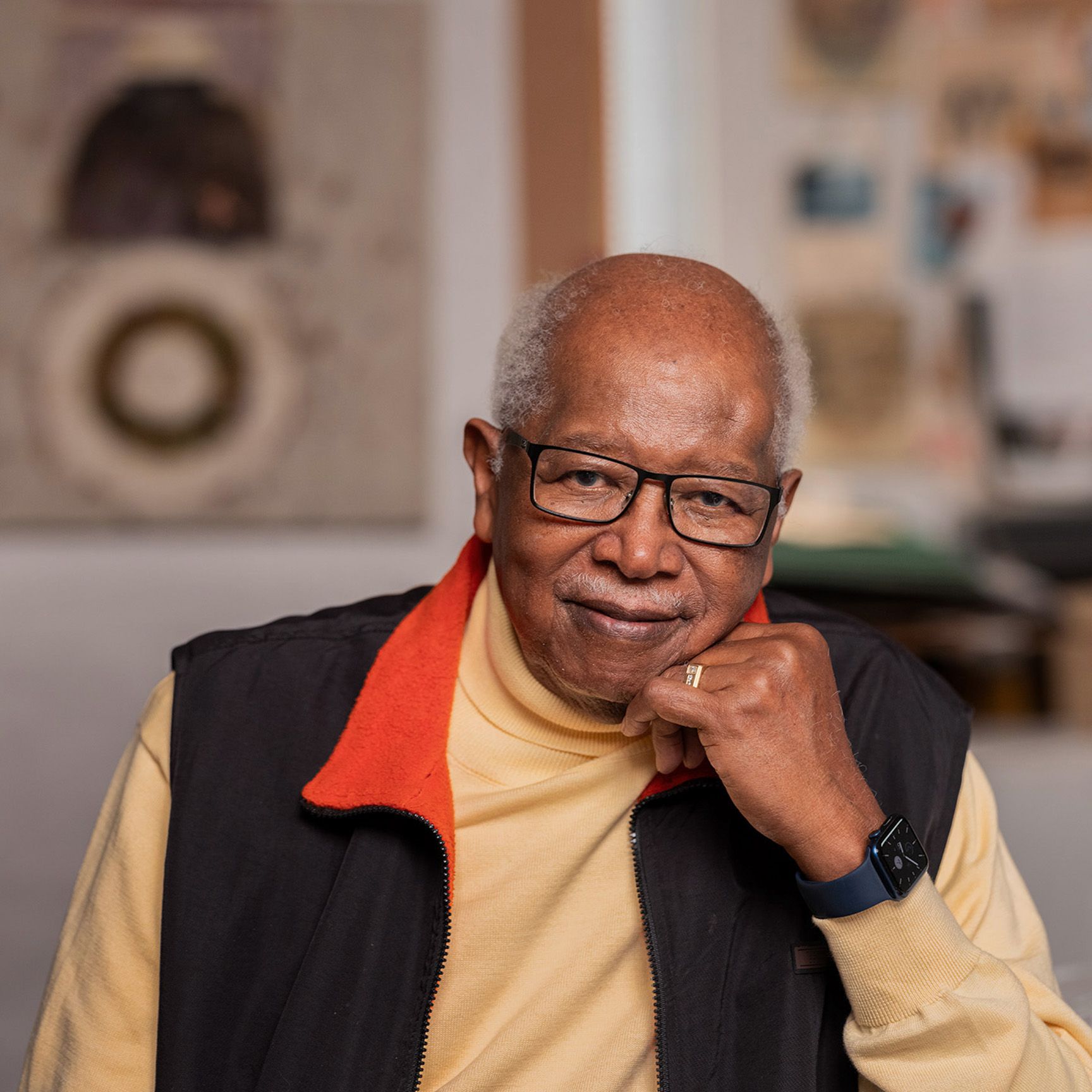
Dr. Leo Twiggs was in born in 1934 in Saint Stephen, South Carolina. The nationally acclaimed artist and educator was his family’s first college graduate; the first African American student to receive a Doctorate from the University of Georgia; and the first visual artist to receive the Governor’s Trophy for Outstanding Contributions to the Arts in South Carolina (the Elizabeth O’Neill Verner Award). Pictured left is the artwork The Swing (batik on cotton, 1970).
He has presented more than seventy-five solo exhibitions, and his work has been featured in numerous group shows nationally and internationally, including U.S. Embassies in Rome, Dakar, and Switzerland, among other venues.
His many accolades include: the Order of the Palmetto (South Carolina’s highest civilian honor); the 1858 Prize for Contemporary Southern Art/Gibbes Museum of Art; and was inducted in 2020 into the South Carolina Hall of Fame.
At South Carolina State University he taught from 1973 until 1998. During his tenure at the university, he started the Art Department and was instrumental in opening and directing the I. P. Stanback Museum and Planetarium on campus. Twiggs was named professor emeritus in 2000.
Twiggs received his Bachelor of Arts degree from Claflin University in 1956 (summa cum laude with majors in art, history, and English); studied at the Art Institute of Chicago; his Master of Arts degree from NYU in 1964; and earned his Doctor of Education from the University of Georgia in 1970. He retired from teaching in 1998 but retains the position of Distinguished Artist in Residence at Claflin University.
Watch the South Carolina Educational Television (SCETV) documentary about the artist at scetv.org/watch/arriving-leo-twiggsand-his-art. SCETV praises Twiggs as “the most influential Black artist in the southeastern United States.”
The retrospective at the Gibbes Museum will feature a special section with replicas of five of the nine stained-glass windows designed by Twiggs in 2007, commissioned for the James and Dorothy Z. Elmore Chapel at Claflin University (completed in 2008). The windows are a departure from his usual media. The intricate designs are based in part upon traditional patterns in Ghanaian fabric, combined with patterns taken from quilts by his grandmother. Added to these designs are images of intertwined single-helixical threads, a reference to art as a preservation of the pulse of life itself.
About the Gibbes Museum of Art
The Gibbes Museum of Art, a beacon in the American South for arts and culture since 1858 when the Museum’s art collection was founded as the Carolina Art Association, is heralded as one of the earliest and most longstanding arts institutions in the United States. The Museum’s collection spans 350 years, and features some of the country’s most celebrated artists ‒ including contemporary, modern and historical works. With world-class rotating exhibitions and a dynamic visiting artist residency program, the Gibbes is a southern museum with a global perspective. The Museum’s mission is to enhance lives through art by engaging people of every background and experience with art and artists of enduring quality, providing opportunities to learn and discover, to enjoy and be inspired by the creative process. Visitor info HERE.