

A print on a swimsuit is doing a job that a print on a dress never has to do. It has to hold together while the fabric stretches over a curve and goes into the water, and the shopper judging it on a screen sees none of that — only a flat photograph of a garment lying still.
That gap between the flat photo and the worn garment explains a good share of the disappointment that arrives in the mail. Four variables decide how a pattern reads once it is on a body: the scale of the motif, how it distorts under stretch, where it lands, and how loud its color runs.
Scale Is Measured Against The Panel, Not The Person
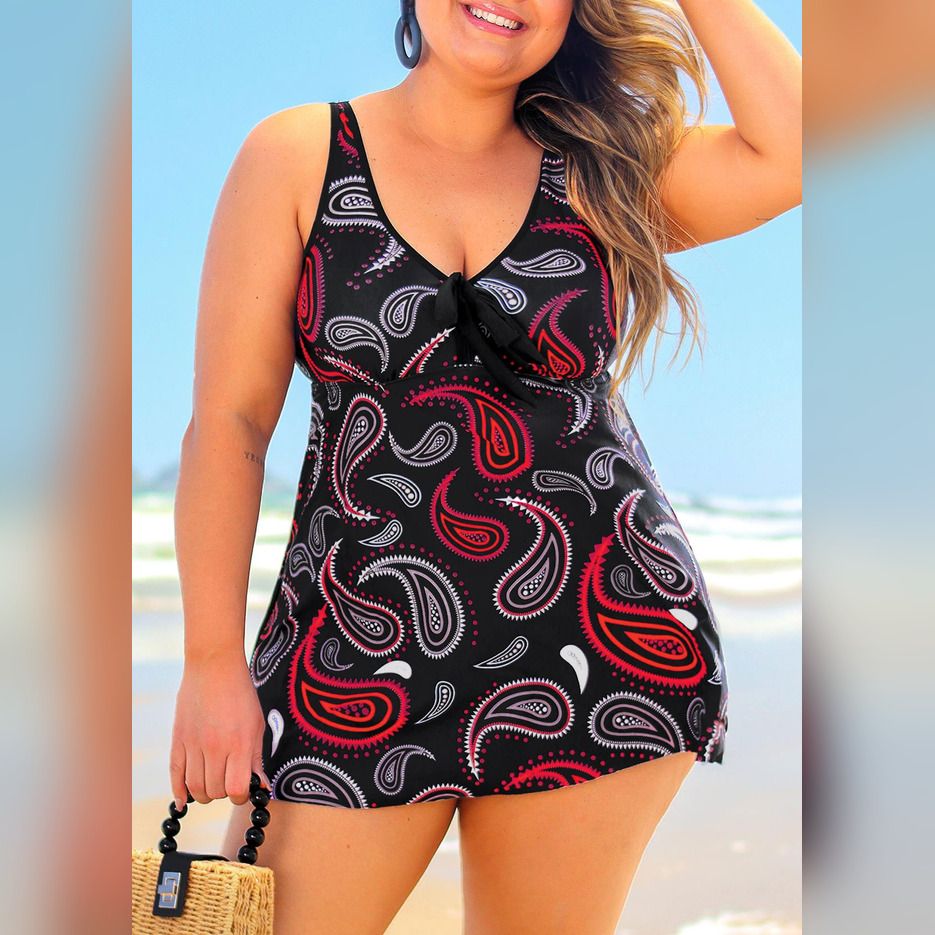
Paisley Print Cross Strap Plus Size Black Swimdress Top
Scale gets discussed as a body question when it starts as a geometry question. A motif repeats across fabric at a fixed interval, and what matters is how many times that interval fits inside the panel it is printed on — the front of a one piece, a triangle cup, a hip section.
Repeat a motif twenty times inside one panel and the eye stops seeing flowers. It sees texture, and it reads the shape underneath. Repeat it twice and each bloom becomes a graphic object with its own hard edge, and the eye tracks those edges instead of the silhouette. Same print, opposite effect.
Somewhere around a two to three inch motif is where adult swim prints tend to sit, because that size stays legible without taking over the garment. Treat it as a starting reference rather than a rule, because the reference moves as soon as the panel it sits on changes size.
Size range stops being a merchandising detail here and turns into a design one. A motif engineered for a size four front panel repeats many more times across a size twenty two, which changes the reading entirely. Collections developed as plus size swimwear from the pattern stage, rather than graded up from a base size, tend to rescale the print to match the panel it lands on.
Prints Move With The Fabric, And That Is The Whole Trick
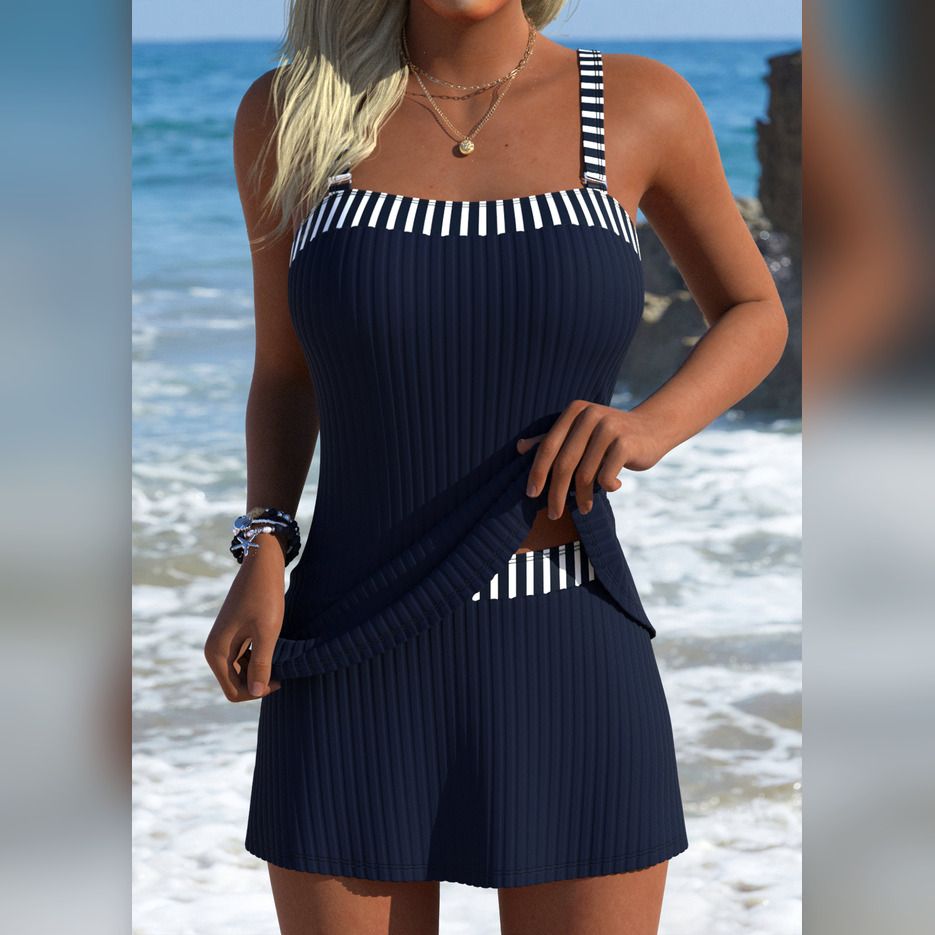
Navy Mid Waisted Striped Tankini Set
Swim fabric arrives at the body under tension. It is cut smaller than the shape it covers and stretches to get there, which means every printed line on it is stretched too — more across the fullest part of a curve, less toward the edges, never uniformly.
Geometry shows this immediately. A grid that looks square on a hanger opens into a diamond across the bust or hip, and a printed circle turns into an oval. Organic prints absorb the same distortion without announcing it, because a stretched leaf still reads as a leaf while a stretched square reads as an error.
Seams are the other tell. Stripes and repeating geometrics have to line up where two pieces join, and when they miss, the eye finds the break instantly. Busy florals hide that break, which is part of why they feel like a safe pick — half of that safety is forgiveness, not flattery.
The practical move is to open the detail shots rather than the flat lay. Side seams, the join under the bust, the center back: those are the places where a print either continues cleanly or jumps. A listing willing to show those angles is telling you something a styled hero image cannot.
Placement Does More Work Than The Motif Itself
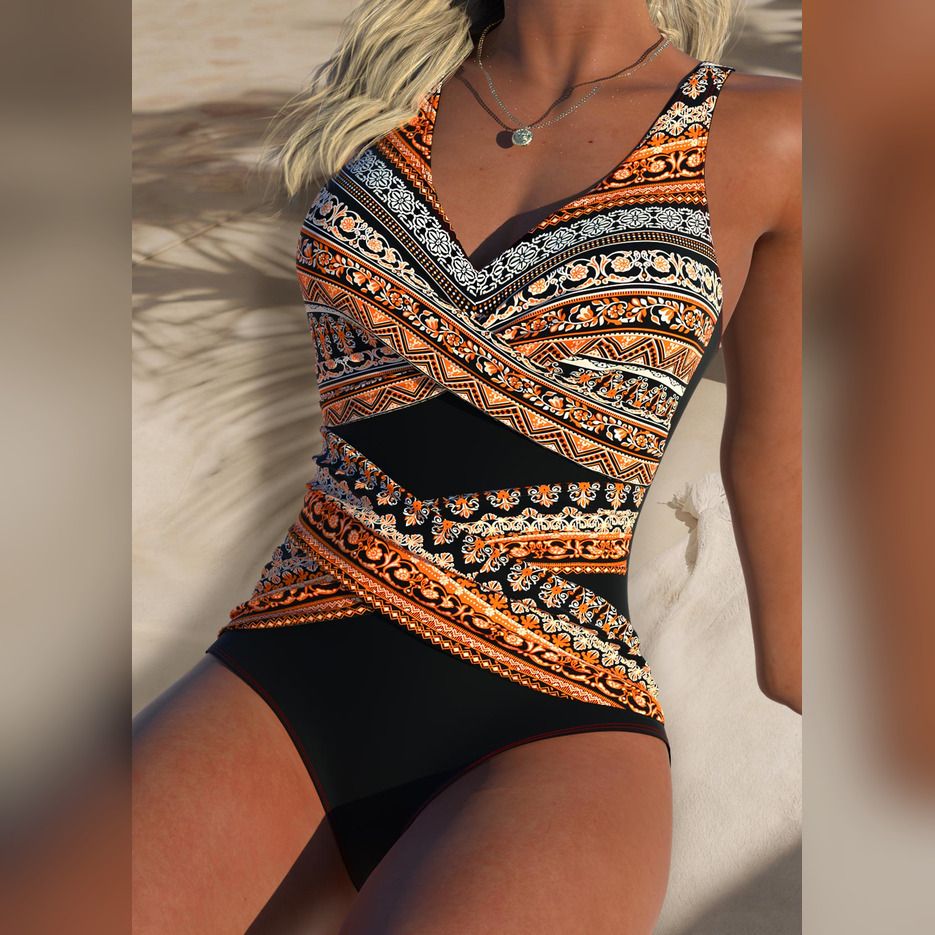
Black Surplice Tribal Print One Piece Swimwear
Two garments cut from the same yardage can read as different products depending on where the print lands. Directional patterns carry a built-in line, and that line either follows the body or cuts across it. A stripe running down a side panel does something a stripe wrapping the waist never will.
Dark and light passages behave the same way. A print with heavy pigment gathered low and airier motifs up top pulls attention upward with no shaping seam involved at all. Reverse the arrangement and the eye settles at the hem instead. The motif never changed; its position did.
Filtering by that logic gets further than filtering by flower type. Anyone browsing swimwear learns more by asking where the print sits and which way it runs than by sorting florals from geometrics, since two florals with opposite placement behave like unrelated garments.
Mixing handles the rest. A printed top over a solid bottom hands the pattern one clear job and lets the other half stay quiet, and the arrangement works just as well flipped. Separates make that possible without committing an entire garment to a single decision.
Color Count Sets The Volume
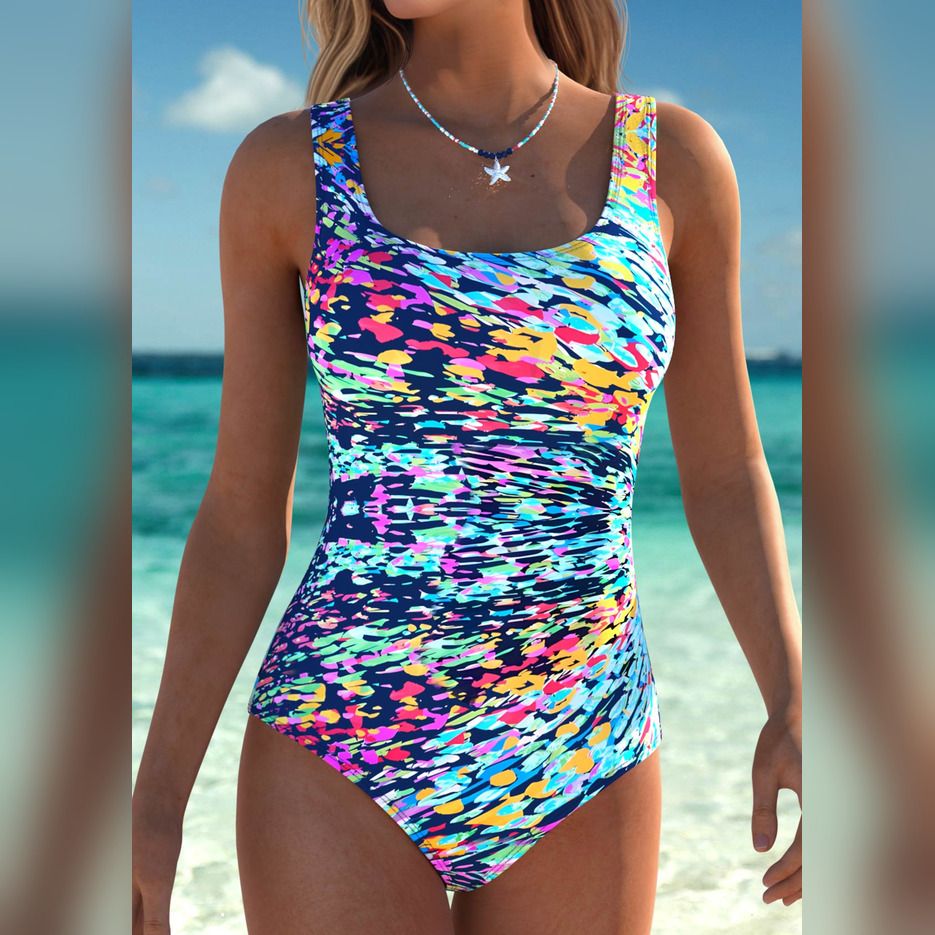
Tummy Control Graffiti Print Multi Color One Piece Swimwear
Loudness comes from color rather than from motif. A palm print in three colors reads as a quiet textile; the same palm print in seven reads as a statement. Neither is wrong, and they are simply different volumes suited to different afternoons.
Two or three colors makes a workable ceiling for a pattern that has to sit near skin and hold up in bright light. Past that count the motifs begin competing with one another, and the print loses whatever structure was holding it together.
Temperature counts as much as quantity. Warm reds and oranges advance visually while blues and greens recede, so an identical layout can push forward or settle back depending only on which half of the wheel it draws from. Water pushes this further, since reflected light lifts contrast a step above what any screen shows.
Scale, distortion, placement, volume. Four questions, none of which require knowing a body type, and all of which can be asked of a product photo before anything reaches a cart. A print that answers all four is one that still looks deliberate hours into a bright day.