

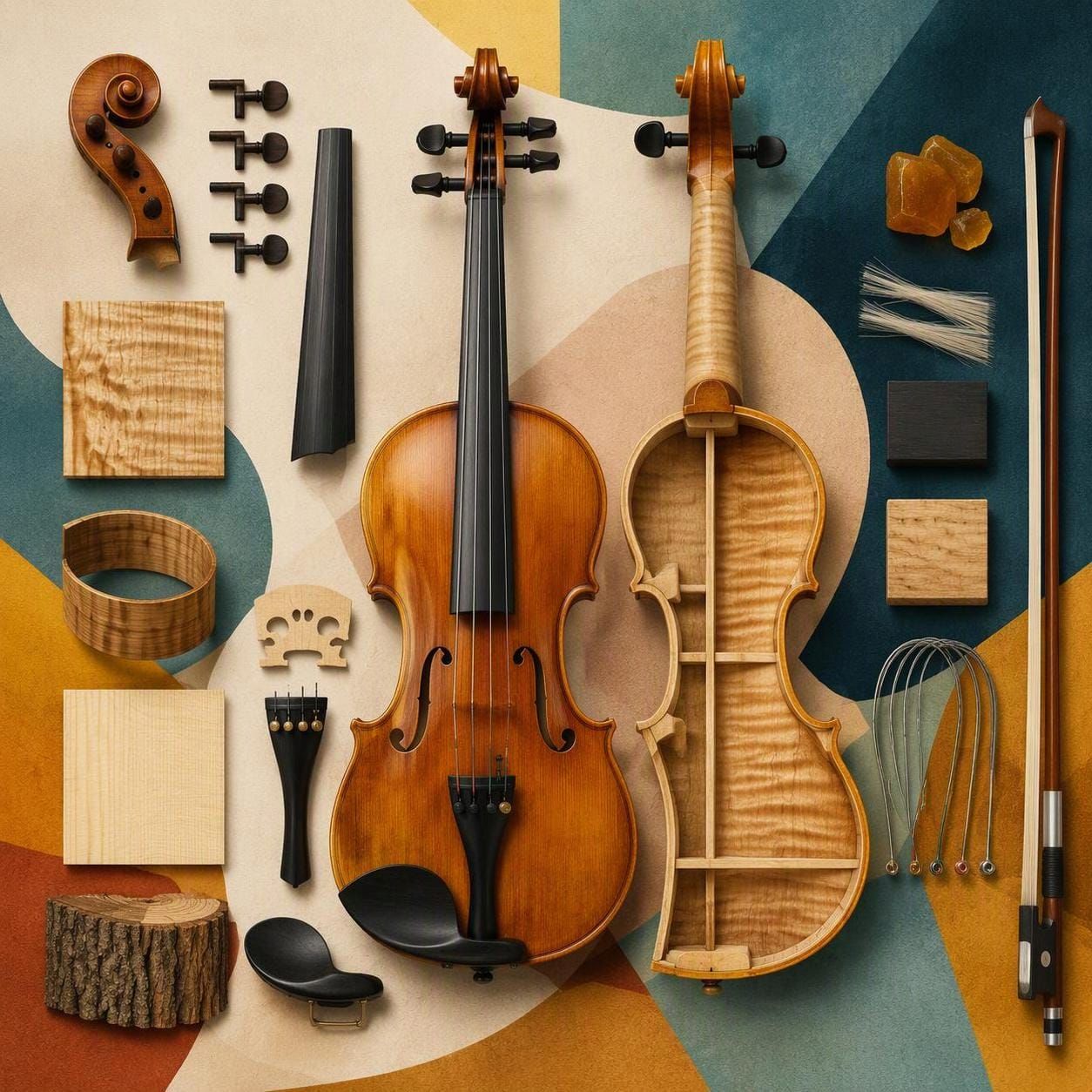
Look at the violin. It sounds simple enough. A wooden box, smooth, with a couple of strings on top. But the closer you approach, the more you see it is an amazing achievement of engineering. No batteries. No amplifiers. No digital tricks. But a violin is all cunning design and natural materials to turn a rapid scrape of horsehair into a rich, full voice.
If you’re even considering playing, studying how these instruments are constructed makes the entire experience less scary. It also provides you a lot better sense of what to look for when buying for a beginner violin, so you end up with an instrument that feels nice to play.
The Wood That Gives the Violin Its Voice
A violin’s music begins long before a bow touches it. It starts with trees. The instrument builder doesn’t just pick up any board from the hardware store. They pick special woods that have been air dried and seasoned for years so they can endure steady vibration without shattering.
Spruce for the top:
The top plate or face of the violin is nearly usually made of spruce. The spruce is light, but curiously rigid. It is this strength which enables it to endure the heavy downward pressure of the strings and to bend sufficiently to vibrate freely.
Maple back, sides and neck:
The rest of the body is maple, a very sturdy wood. The maple functions like a backboard, bouncing the sound back out into the room rather than absorbing it. It has those wonderful wavy grain patterns you generally see on the back of good instruments.
The correct mixture of these two woods provides the violin with a balanced, pleasant tone that only becomes better with age when the instrument is played.
The Body That Resonates Every Vibration
The vibrating string itself is actually fairly quiet. You could stretch a string over a simple board and hardly get any sound. That little vibration is turned into real volume by the hollow body.
- Top and rear plates: These two carved wooden shells hold the air of the instrument. The plates bend as the strings vibrate and pump that air around to create acoustic power.
- The ribs: The thin strips of wood that form the sides. They place the front and back plates far enough apart to generate the interior air chamber.
- Shape and thickness: That classic hourglass form isn’t simply a look. The small waist lets your bow clear the sides without striking the wood. And manufacturers shave the wood precisely, so it’s thicker in the middle and thinner on the edges, which helps the instrument vibrate evenly between high and low notes.
Factory-made violins tend to be heavier, with thicker, sturdier walls that can take the beating of student use. Hand-carved violins have thinner walls that respond a little quicker to a delicate touch.
The Strings That Produce the Sound
The strings are the beginning of every note. You draw a bow across a string. The friction forces the string ahead until it snaps back, and it does this hundreds of times each second.
- Steel core strings: Highly popular with novices as they stay in tune quite well and don’t snap easily. They often sound bright and straightforward.
- Synthetic core strings: These strings are made of nylon-like fibers and sound warm and classic like the old gut strings, but without the constant tuning required to compensate for room temperature variations.
- Gut strings: The classic option, made from sheep guts. They sound quite beautiful and sophisticated but are fragile and very sensitive to dampness.
Getting the appropriate set of strings is a major concern for novice musicians. If you get the string tension right, it is much easier to push down on the fingerboard with your fingertips.
The Bridge That Carries the Quivers
The bridge is right on the violin. The strings are stretched over a thin unpolished piece of maple called the bridge, but its principal duty is to transmit vibration.
- The burden of weight: The force exerted by the tensioned strings on the bridge is considerable.
- Passing the energy: Those vibrations in the strings fall down through the feet of the bridge right into the spruce top.
A decent bridge needs to be custom fit for the instrument. Feet should be fully flush with the curving top. If the bridge is off-center or not adequately shaped, the sound will be muffled and the bridge can slide or warp.
Internal Parts and Soundpost
Inside the black interior of the violin are two hidden pieces that do a lot of heavy labor behind the scenes.
- The soundpost: A small wooden dowel inserted vertically between the front and back plates slightly below one side of the bridge. It is termed the heart of the violin because it carries the vibrations straight to the back of the instrument. Without it, the violin loses much of its force and resonance.
- The bass bar: A thin strip of wood bonded along the length of the underside of the top plate. It supports the wood under the strain of the strings and helps to distribute the low-pitch vibrations.
You may never see these internal elements during a normal practice session, but the exact location of them makes a big impact in how the violin responds to your playing.
Fingerboard, Pegs and Fittings
But a violin also needs gear to be able to tune it, to hold it and to change notes easily.
- Fingerboard: The long, black piece of wood fastened to the neck. It is usually crafted from ebony since ebony is a highly durable wood and will not wear away quickly with your fingertips.
- Tuning pegs: These are the wooden pegs in the pegbox at the top, and you tighten or loosen the strings to keep them in tune.
- Tailpiece, chin rest, endpin: The tailpiece secures the bottom of the strings. The chin rest provides a comfortable spot for your jaw to rest, making it simpler to hold the violin up without straining your neck.
The Bow That Makes the Violin Live
You really can’t discuss a violin without discussing the bow. It’s the bow that drives the whole thing.
- The stick: Usually made of solid woods such as brazilwood or pernambuco however carbon fiber bows are hugely popular these days as they are nearly indestructible.
- The hair: Real horsehair is utilized as it has a natural texture to hold the string.
- The frog and screw: The frog holds the hair at its lower end and the small metal screw is twisted to change the tension on the hair.
A bow that’s well-balanced is easy to manipulate, so you can get a clean sound without bearing down too hard.
All Things Are Connected
When you drag the bow over a string, a rapid chain reaction occurs:
- The horsehair snags the string and releases it, and the vibrations begin.
- The rope brings the energy down into the wooden bridge.
- The movements are conveyed by the bridge to the top plate, and by the sound post to the back.
- The complete wooden body vibrates, sending sound waves out of the f-shaped holes on the front of the body.
Once all the parts are in place, the instrument plays without effort.
Summary
A violin is not merely carved wood. The spruce top, the maple back, the small sound post inside, each piece is part of the puzzle that makes that unique sound. If you know how these parts fit together you are a lot better player for it. It teaches you how to take care of your gear, how to maintain it and finally how to choose a beginner violin that feels nice in your hands from day one.